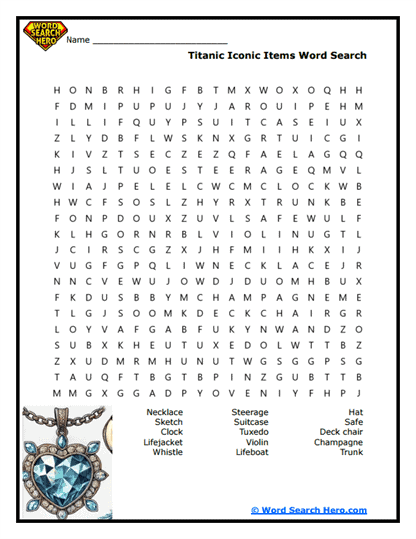
About Our Titanic Word Searches
Our Titanic Word Searches bring one of the most famous films in cinematic history into a fun and educational experience. These printable puzzles are perfect for classrooms, homeschool settings, or at-home activities, combining the emotional storytelling of the movie with meaningful literacy practice. Centered around the film’s characters, setting, and unforgettable moments, this collection helps students engage with vocabulary in an exciting and memorable way.
Students will search for words like “ship,” “iceberg,” “voyage,” “Jack,” “Rose,” and “survival,” all while strengthening spelling, reading fluency, and focus. Because Titanic blends romance, history, and drama, these puzzles introduce a wide range of vocabulary that connects to both storytelling and real-world events. Teachers often use them during film studies, history lessons, or as a themed activity that captures student interest.
These printables are easy to use with no prep required, making them ideal for busy educators and parents. They can be adapted for different grade levels, allowing younger students to work with simpler terms while older learners explore more detailed vocabulary tied to the film and its historical context.
Beyond skill-building, these puzzles help students connect language to powerful narratives. By linking vocabulary to a story many recognize, learners develop stronger comprehension and a deeper appreciation for both history and storytelling.
Exploring Vocabulary from Ship to Story
Titanic-themed puzzles offer a rich mix of vocabulary that spans both maritime terms and emotional storytelling. Words like “deck,” “captain,” “lifeboat,” and “collision” introduce students to nautical language, while words like “love,” “promise,” and “farewell” reflect the film’s emotional core. This combination helps students expand their vocabulary across multiple contexts.
A helpful classroom strategy is to have students sort words into categories such as ship-related terms, character names, and emotions. For example, grouping “engine,” “anchor,” and “voyage” separately from “hope” and “loss” helps students see how different types of vocabulary contribute to both setting and story.
You can also extend the activity by having students write a short scene or journal entry using several of the words they found. This reinforces vocabulary while encouraging creative thinking. Even a brief description of a moment on the ship can help students connect words to meaning.
Because the theme blends real history with storytelling, these puzzles create a strong connection between factual learning and imagination. This makes the activity more engaging and helps students retain what they’ve learned.
Paul’s Pro-Tip

One thing I always noticed is that when a story has both action and emotion, students really lean into it. With Titanic, I’d start by asking what they already knew about the ship or the story. That quick discussion got them curious and made the puzzle feel like part of a bigger experience instead of just a worksheet.
After they finished, I liked to have students pick one word and explain how it connects to either the story or the real event. It didn’t have to be long, but it got them thinking a little deeper. And if someone got stuck, I’d remind them to look for longer words first-those tend to stand out and can make the rest of the puzzle easier to solve.
Connecting Titanic to History and Learning
Titanic-themed word searches naturally connect to multiple subject areas, making them a powerful classroom tool. In social studies, students can explore the real history of the Titanic, including its voyage, passengers, and the events surrounding its sinking. Vocabulary from the puzzle can serve as a starting point for deeper discussions about history and human experience.
In language arts, these puzzles support lessons on storytelling, character relationships, and emotional themes. Students can analyze how words reflect tension, hope, and loss, and how those ideas shape the narrative.
Science connections can also be introduced, such as buoyancy, ocean conditions, and why icebergs are dangerous to ships. This adds another layer of learning while keeping the activity engaging.
Creative extensions work well too. Students might design a movie poster, write an alternate ending, or create a diary entry from a passenger’s perspective using words from the puzzle. By connecting vocabulary to multiple subjects, these puzzles provide a well-rounded and memorable learning experience.
Frequently Asked Questions
What are Titanic word searches and how do they work?
Titanic word searches are printable puzzles that include vocabulary related to the famous movie and the real historical event. Students search for hidden words in a grid, helping them build spelling, reading, and word recognition skills in an engaging way.
Is Titanic an appropriate theme for classroom activities?
Yes, when presented thoughtfully, the focus can be on history, storytelling, and human experiences rather than intense moments. Teachers and parents can guide the discussion to ensure it remains appropriate and educational for their students.
How do Titanic word searches support learning?
They improve vocabulary and reading fluency by encouraging students to recognize and locate words. When paired with writing or discussion activities, they also support comprehension, critical thinking, and connections to real-world history.
Can these puzzles be used in history lessons?
Absolutely, they are a great addition to lessons about the Titanic and early 20th-century history. The vocabulary provides a natural entry point for discussing the ship, its journey, and the people involved.
Why do students enjoy Titanic-themed activities?
Students are drawn to the combination of real history and dramatic storytelling. When learning connects to a powerful and well-known story, it becomes more engaging, helping students stay focused and remember what they’ve learned.