


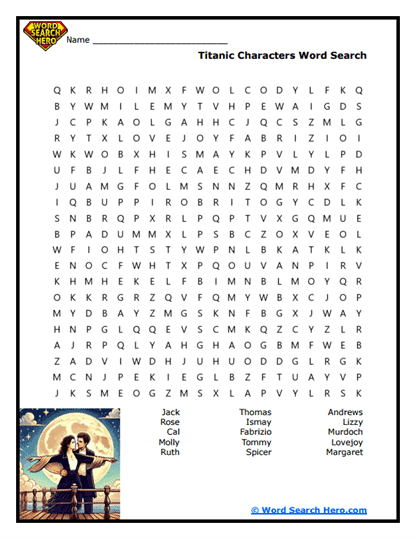
Titanic
Packed with steamy stares, iceberg oopsies, and enough 1912 flair to make your grandma blush, this collection is basically the most fun you can have without boarding an actual doomed ocean liner.
Our Tragic Love Story Movie Word Searches explore the emotional depth and powerful storytelling found in some of the most unforgettable films. These printable puzzles are perfect for classrooms, homeschool settings, or at-home learning, offering a meaningful way to combine literacy practice with thought-provoking themes. Centered around stories of love, loss, sacrifice, and difficult choices, this collection helps students engage with vocabulary that carries strong emotional meaning.
Students will encounter words like “heartbreak,” “farewell,” “sacrifice,” “destiny,” and “loss,” all while strengthening spelling, reading fluency, and concentration. Because tragic love stories focus on emotional journeys, these puzzles introduce vocabulary that helps students better understand and express complex feelings. Teachers often use them as part of literature or film units, writing prompts, or reflective activities.
These printables are easy to use with no preparation required, making them a convenient option for both educators and parents. They can be adapted for different grade levels, allowing younger students to work with simpler terms while older learners explore deeper, more nuanced vocabulary.
Beyond skill-building, these puzzles encourage students to think about storytelling, character decisions, and emotional impact. By connecting words to meaningful narratives, learners develop stronger comprehension and a deeper appreciation for language.
Tragic love story themes are rich with expressive language that helps students expand their emotional vocabulary. Words like “grief,” “longing,” “separation,” and “devotion” introduce learners to ways of describing feelings that go beyond basic terms. This not only improves reading comprehension but also strengthens writing and communication skills.
A helpful strategy is to have students sort the words they find into categories such as emotions, actions, and outcomes. For example, they might group “love” and “hope” separately from “loss” and “goodbye.” This helps students see how different words contribute to the emotional arc of a story.
You can also extend the activity by asking students to write a short reflective paragraph or scene using several of the words from the puzzle. This encourages them to apply vocabulary in context and think more deeply about how language shapes meaning.
Because the theme is emotionally engaging, students often connect more personally to the activity. This connection helps improve retention and makes the learning experience more impactful and memorable.

One thing I noticed over the years is that when students connect emotionally to a topic, their focus improves without you having to push it. With tragic love story themes, I’d start by asking students what makes a story “sad but meaningful.” That question alone got them thinking, and it made the puzzle feel more important than just finding words.
After they finished, I liked to have students choose one word and explain how it might fit into a story or a character’s decision. It didn’t have to be long-just thoughtful. That simple step helped them connect vocabulary to real ideas. And if someone got stuck during the puzzle, I’d remind them to look for familiar patterns like prefixes or endings, which often make tricky words easier to spot.
Tragic love story puzzles offer strong opportunities to connect learning across subjects. In language arts, they support lessons on plot structure, character development, and theme. Students can explore how stories build emotional tension and how characters respond to challenges or difficult choices.
These puzzles can also lead to meaningful discussions about decision-making and consequences. Students can reflect on how characters’ actions affect outcomes, helping them develop critical thinking and empathy. This makes the activity both academic and personally relevant.
Creative extensions work especially well with this theme. Students might write an alternate ending, create a character diary entry, or design a movie poster using words from the puzzle. These activities reinforce vocabulary while encouraging imagination and deeper engagement.
Real-world connections can also be explored by discussing how emotions like love, loss, and hope appear in everyday life. By linking vocabulary to both stories and real experiences, these puzzles help students build stronger communication skills and emotional awareness.
These are printable word search puzzles that focus on vocabulary inspired by emotional love stories in films. They include words related to relationships, loss, and storytelling, making them both engaging and educational for students.
Yes, when presented thoughtfully, these themes focus on emotions and storytelling rather than anything inappropriate. Teachers and parents can guide discussions to ensure the content remains age-appropriate and meaningful.
They expose students to expressive and descriptive words that help build a stronger understanding of language. When combined with writing or discussion activities, they also improve comprehension and the ability to express ideas clearly.
Absolutely, they are a great addition to lessons on storytelling, character development, and theme. The vocabulary provides a foundation for creative writing and deeper analysis of narratives.
Emotional themes help students connect more deeply with the material, which improves focus and retention. When students relate to the words and ideas, they are more likely to engage and remember what they’ve learned.