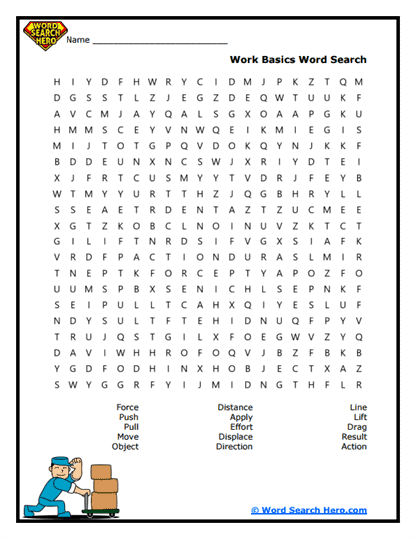
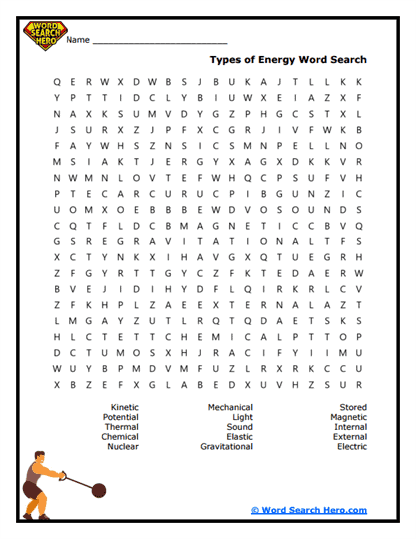
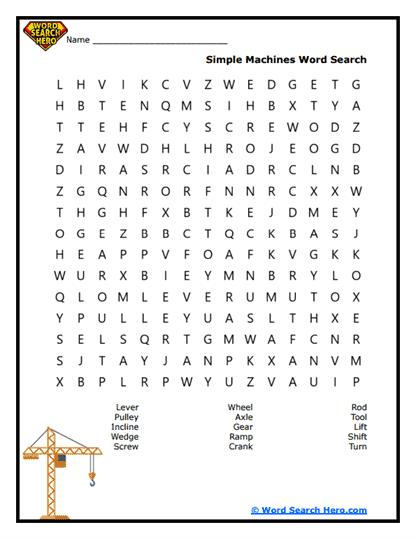
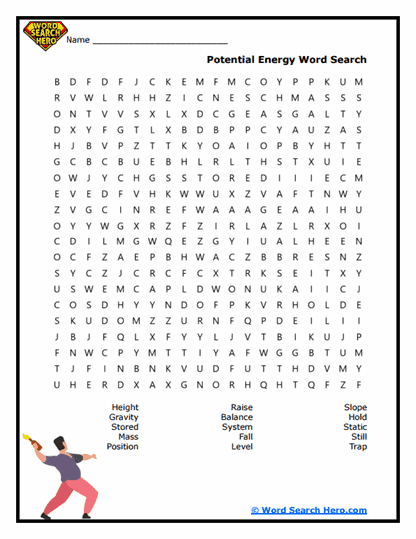
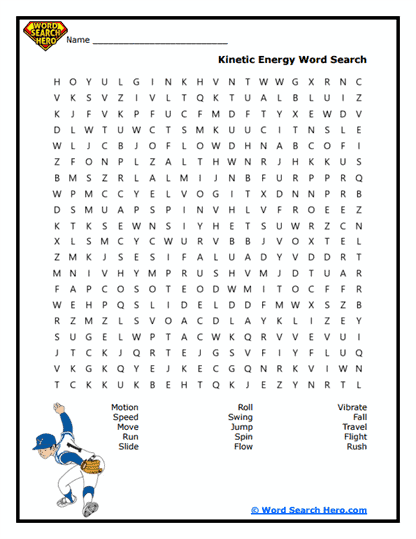
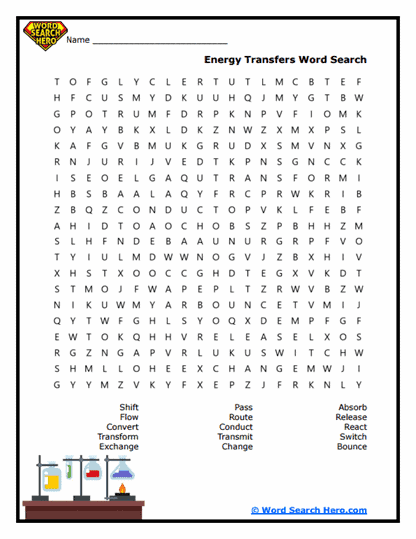
About Our Work, Energy, and Power Word Searches
Work, Energy, and Power word searches introduce students to the vocabulary used to describe how forces move objects and how energy is transferred and used in physical systems. These printable puzzles help learners become familiar with scientific terms related to motion, force, energy transfer, and the rate at which work is done. Before students explore these physics concepts in depth, it often helps to first recognize the language scientists use to describe how energy and motion interact.
Students studying work, energy, and power may encounter words such as work, energy, power, force, motion, effort, transfer, and mechanical. These terms frequently appear in physics lessons and help students understand how objects move when forces are applied and how energy allows work to be performed. A word search provides an engaging way to reinforce this vocabulary while strengthening reading, spelling, and observation skills.
Because the activity feels like a puzzle rather than a traditional worksheet, it can make scientific vocabulary easier and more engaging to learn. Teachers often use these printables during science centers, independent practice, review sessions, or early finisher activities. Parents and homeschool educators can also include them in lessons as a way to introduce energy and motion vocabulary in an interactive format.
As students search for the words in the puzzle grid, they strengthen concentration, visual scanning, and pattern recognition skills. At the same time, they build familiarity with the scientific language used to describe how forces and energy interact.
Understanding Work, Energy, and Power
In physics, work occurs when a force causes an object to move. This means that energy is transferred when an object is pushed, pulled, lifted, or otherwise moved by a force.
Energy is the ability to do work. It exists in many forms, including mechanical energy, thermal energy, and electrical energy. When energy moves from one object or system to another, it allows work to take place.
Power describes how quickly work is done or how quickly energy is transferred. A machine that performs the same amount of work in less time is considered more powerful.
These ideas help scientists and engineers understand how machines operate, how energy is used in physical systems, and how different devices perform tasks.
Learning the vocabulary associated with work, energy, and power helps students understand how motion and energy interact in the physical world.
Word searches reinforce this learning by giving students repeated exposure to the key terms used when studying energy and mechanical systems.
Paul’s Pro-Tip
A powerful extension activity is a “lifting challenge investigation.” After students complete the word search, give them a small object such as a book and ask them to lift it from the floor to a desk or table.
Students can repeat the task slowly and then more quickly while discussing what changed. Guide them to think about how the work performed stayed the same, but the rate of completing the task changed.
This simple demonstration helps students understand the concept of power as the rate at which work is done. Teachers and homeschool educators can extend the activity by comparing how long it takes different students to complete the same lifting task and discussing why machines are often designed to increase efficiency.
Helping Students Understand Energy in Motion
Work, energy, and power are foundational ideas in physics because they explain how forces move objects and how energy is transferred in mechanical systems. These principles help scientists and engineers design machines, vehicles, and technologies that perform tasks efficiently.
Understanding work, energy, and power vocabulary helps students interpret physics experiments, diagrams of mechanical systems, and discussions about energy use. These concepts also connect to broader topics such as engineering design, energy systems, and mechanical advantage.
A word search can serve as an introduction to a lesson about energy and motion or as a review after students have studied mechanical systems in class. After completing the puzzle, educators can encourage students to connect the vocabulary with real-world examples such as lifting objects, operating machines, or using tools.
When students become familiar with work, energy, and power vocabulary, they gain the language and understanding needed to explore how forces and energy interact to produce motion and accomplish tasks.
Frequently Asked Questions
What is work in physics?
Work occurs when a force causes an object to move from one place to another.
What is energy?
Energy is the ability to do work or cause change in a physical system.
What is power?
Power describes how quickly work is done or how quickly energy is transferred.
Why are work, energy, and power important?
These concepts help scientists understand how machines operate and how energy is used to perform tasks.
What classroom activity pairs well with this puzzle?
Students can lift the same object at different speeds to explore how the rate of completing work relates to power.