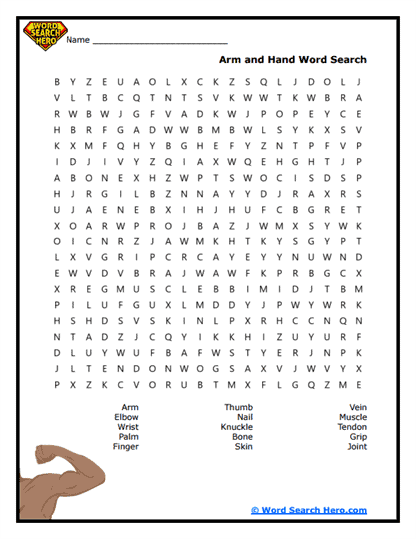
About Our Body Parts Word Searches
Body Parts word searches introduce students to the vocabulary used to describe the different parts of the human body. These printable puzzles help learners become familiar with common anatomy terms while strengthening reading, spelling, and observation skills. Before students explore more advanced topics about how the body works, it often helps to first recognize the names of the body’s major structures.
Students studying this topic may encounter words such as arm, leg, heart, brain, lungs, stomach, and skin. These terms appear frequently in health and life science lessons, and recognizing them helps students better understand how the body is organized. A word search provides a fun and engaging way to reinforce these terms while building vocabulary related to human anatomy.
Because the activity feels like a puzzle rather than a traditional worksheet, it can make learning science vocabulary more enjoyable. Teachers often use these printables during science centers, independent practice, review sessions, or early finisher time. Parents and homeschool educators can also easily include them in lessons as a way to introduce anatomy vocabulary in an interactive format.
As students search for the words in the puzzle grid, they strengthen concentration, visual scanning, and pattern recognition skills. At the same time, they are becoming more familiar with the names of important body parts they will encounter in health and science lessons.
Learning the Major Parts of the Human Body
The human body is made up of many different parts that work together to help us move, think, breathe, and stay healthy. Some body parts are visible, such as the hands, feet, eyes, and ears. Others are located inside the body, including organs like the heart, lungs, and stomach.
Each body part plays an important role. For example, the brain helps control thoughts and actions, the lungs help the body breathe, and the heart pumps blood throughout the body. Even smaller parts such as muscles and bones help support movement and strength.
Understanding the names and functions of body parts helps students learn how their bodies work and how to take care of them. This knowledge also builds a foundation for later topics in anatomy, biology, and health science.
Word searches reinforce this learning by giving students repeated exposure to the terms used to describe different parts of the body.
Paul’s Pro-Tip
A simple but highly effective extension for this puzzle is a “point and identify” activity. After students complete the word search, ask them to point to several of the body parts listed in the puzzle on their own body or on a classroom diagram.
Students can then explain what each part helps the body do. For example, they might say that the eyes help us see or that the legs help us walk and run.
This activity adds strong instructional value because it connects vocabulary with physical awareness. Teachers and homeschool educators can also quickly check whether students understand the purpose of each body part rather than simply recognizing the word.
Helping Students Understand Their Own Bodies
Learning about body parts helps students develop a better understanding of their own health and physical development. When students recognize the names of different body parts, they are better able to describe injuries, understand health instructions, and communicate about their bodies.
This vocabulary also prepares students for more advanced lessons about body systems, anatomy, and biology. Recognizing the parts of the body is often the first step toward understanding how those parts work together to support life.
A word search can serve as an introduction to a human body unit or as a review after students have studied anatomy in class. After completing the puzzle, educators can encourage students to connect the vocabulary with diagrams, health lessons, or discussions about how to care for their bodies.
When students build confidence with body part vocabulary, they gain the language and understanding needed to explore the structure and function of the human body.
Frequently Asked Questions
Why is it important for students to learn the names of body parts?
Knowing the names of body parts helps students understand basic anatomy and communicate clearly about health and movement.
At what grade levels are body parts word searches most useful?
They are especially helpful for younger students learning basic science and health vocabulary.
Do body parts word searches support health education?
Yes. They reinforce vocabulary that appears in both life science and health-related lessons.
Can these puzzles be used in early science instruction?
Absolutely. They work well as an introductory activity when students are first learning about the human body.
What hands-on activity can follow this puzzle?
Students can label a simple diagram of the human body and match each word from the puzzle to its correct location.