About Our Human Body Word Searches
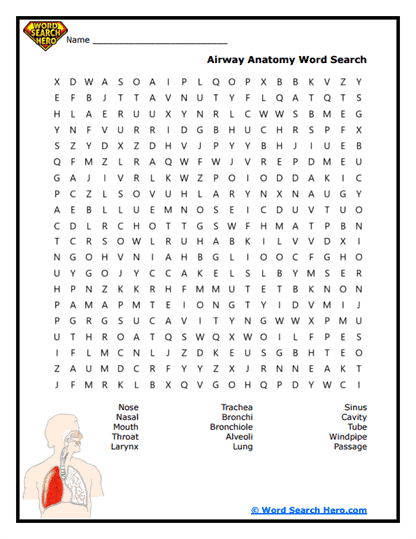
Human Body word searches introduce students to the vocabulary used to describe the structures and systems that keep the body functioning. These printable puzzles help learners become familiar with scientific terms related to anatomy, organs, and body systems while strengthening reading, spelling, and observation skills. Before students explore how the body works in detail, it often helps to first recognize the language used to describe its parts and functions.
The human body is made up of many interconnected systems that work together to support life. Students studying this topic may encounter words such as organ, muscle, skeleton, circulation, digestion, and nervous system. These terms appear frequently in life science lessons and textbooks, and recognizing them helps students better understand how different parts of the body interact to keep us healthy and active.
A word search provides an engaging way to reinforce this vocabulary while encouraging curiosity about how the body works. Because the activity feels like a puzzle rather than a traditional worksheet, it can make science vocabulary practice more enjoyable. Teachers often use these printables during science centers, independent practice, review sessions, or early finisher time. Parents and homeschool educators can also include them in lessons as a way to introduce anatomy vocabulary in an interactive format.
As students search for the words in the puzzle grid, they strengthen concentration, visual scanning, and pattern recognition skills. At the same time, they are building familiarity with the scientific language used to describe the human body.
Understanding the Systems of the Human Body
The human body is made up of several major systems that work together to maintain life. Each system has specific functions that help the body grow, move, and respond to the environment.
For example, the skeletal system provides structure and protection, while the muscular system allows movement. The circulatory system moves blood and nutrients throughout the body, and the digestive system breaks down food so the body can use it for energy.
Learning the vocabulary associated with these systems helps students understand how different parts of the body cooperate to keep us alive and healthy. When students recognize terms related to anatomy and physiology, it becomes easier for them to follow explanations about body processes.
Word searches reinforce this learning by giving students repeated exposure to the key terms used when studying the human body.
Paul’s Pro-Tip
A great way to extend this puzzle is to introduce a “body system connection” activity. After students complete the word search, ask them to choose a few vocabulary words and identify which body system they belong to.
For example, the word muscle relates to the muscular system, while heart belongs to the circulatory system. Students can then explain what role that structure plays in helping the body function.
This activity adds strong instructional value because it encourages students to organize vocabulary into meaningful categories. Teachers and homeschool educators can quickly see whether students understand how individual body parts fit into larger biological systems.
Helping Students Explore Human Anatomy
Understanding the human body helps students learn how their own bodies function and why healthy habits are important. When students become familiar with anatomy vocabulary, they are better prepared to understand lessons about health, nutrition, exercise, and growth.
Learning the language of the body also helps students interpret diagrams, models, and science readings that explain how body systems work. This knowledge supports future learning in biology, medicine, and health science.
A word search can serve as an introduction to a human body unit or as a review after students have studied anatomy in class. After completing the puzzle, educators can encourage students to connect the vocabulary with body diagrams, classroom discussions, or simple experiments related to health and movement.
When students build confidence with human body vocabulary, they gain the language and understanding needed to explore how the body works and how its systems keep us alive.
Frequently Asked Questions
What does the term anatomy mean?
Anatomy refers to the study of the structure of the body and its parts.
Why do students learn about body systems in science?
Studying body systems helps students understand how different organs and tissues work together to keep the body functioning.
How many major systems are in the human body?
There are several major systems, including the skeletal, muscular, circulatory, digestive, respiratory, and nervous systems.
How do the body’s systems work together?
Each system performs specific tasks, but they depend on one another to maintain balance and support overall health.
What activity pairs well with a human body word search?
Students can label a diagram of the human body and identify which system each structure belongs to.