Choose a topic !

Climatology Word Searches

Climate Dynamics Word Search

Climate Dynamics

This word search explores the various components of climate, introducing key terms like temperature, humidity, cloud cover, and barometric trends. Students will search for 18 vocabulary words that help describe and measure aspects of weather and climate systems. This activity builds awareness of atmospheric phenomena and the terminology scientists use to describe climate processes. It’s […]

View More
Zone Safari Word Search

Zone Safari

This worksheet focuses on climate zones around the world, such as tropical, polar, and Mediterranean zones. Students identify 15 climate-related geographic terms, helping them become familiar with different regional climates and their characteristics. The terms reflect a blend of temperature, precipitation, and latitude influences. It’s a great introductory activity to understand global climate classification. The […]

View More
Sky Stack Word Search

Sky Stack

This worksheet introduces students to the layers of Earth’s atmosphere, such as the troposphere, stratosphere, and thermosphere. It includes a mix of scientific vocabulary relating to atmospheric structure and phenomena like jet streams, ozone layers, and lapse rates. These terms are foundational to understanding how the atmosphere behaves and affects weather and climate. Engaging with […]

View More
Weather Tools Word Search

Weather Tools

This worksheet focuses on weather instruments used by meteorologists, such as barometers, hygrometers, and weather balloons. Students learn how these tools help observe and predict weather patterns. The vocabulary ranges from common devices to specialized equipment, giving a comprehensive look at how we measure different elements of the atmosphere. This word search enhances scientific vocabulary […]

View More
Climate Shift Word Search

Climate Shift

This puzzle centers on climate change terminology, highlighting causes, consequences, and related phenomena. Vocabulary includes terms like fossil fuel, glacier retreat, and global trend. Students engage with words tied to ongoing environmental challenges and scientific discussions on global warming. Students expand their environmental science vocabulary and comprehension. They practice scanning for multi-word terms and understand […]

View More
Heat Trap Word Search

Heat Trap

This worksheet revolves around the greenhouse effect and how energy is absorbed and emitted by Earth. Vocabulary includes radiation, longwave, emissivity, and thermal retention. It explains how heat is trapped in the atmosphere and the consequences on Earth’s surface temperature. By exploring these scientific terms, students deepen their understanding of climate science and energy balance. […]

View More
Storm Watchers Word Search

Storm Watchers

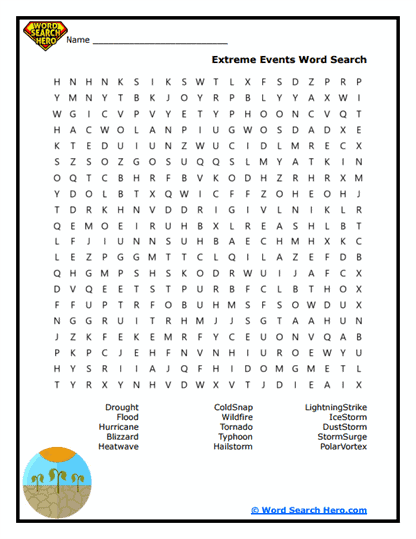
This puzzle focuses on extreme weather events, featuring terms like hurricane, wildfire, hailstorm, and tornado. It covers a wide range of natural disasters across different regions and climates. These terms highlight how severe weather impacts human life and the environment. Searching for these words encourages students to differentiate among types of weather emergencies. It builds […]

View More
Climatology in Motion Word Search

Climatology in Motion

This word search introduces indicators of climate change, such as tree rings, coral bleaching, and sea ice extent. The words reflect how scientists track long-term environmental changes using natural and physical evidence. It includes both biological and geological indicators. Students learn how scientists gather data about climate history and trends. Identifying these terms strengthens their […]

View More
Wind World Word Search

Wind World

This worksheet covers global wind patterns like trade winds, polar fronts, and jet streams. It includes scientific terms related to atmospheric circulation cells and wind-related climate systems. Students explore how wind helps regulate global temperature and weather. This word search builds comprehension of atmospheric dynamics and geography. Identifying complex terms enhances decoding skills and improves […]

View More
Data Dive Word Search

Data Dive

This word search dives into climatological data terminology, featuring terms like time series, interpolation, and simulation. It emphasizes data handling, statistical tools, and analysis methods used in climate science. These words are often encountered in scientific research or environmental reporting. This puzzle builds familiarity with data-related terms that are key in scientific analysis. It supports […]

View More

About Our Climatology Word Searches

Climatology is a field defined by systems-interlocking, nonlinear, and global. Studying it requires precision with language, clarity of concepts, and a firm grasp of the variables at play. Scientific vocabulary isn’t just decorative-it’s functional. Terms like tropopause, zonal mean, and barometric trend aren’t just labels; they’re tools that allow scientists to construct models, detect anomalies, and interpret atmospheric behavior. The word searches in this collection are designed not as diversions, but as structured exercises in visual scanning, concept recognition, and terminology retention, all anchored in core climatological principles.

The structure of this collection reflects the scientific scaffolding of climatology itself: core components, spatial context, instrumentation, analysis, and evidence of change. Climate Dynamics introduces the fundamental variables that define climate as a physical system: temperature, humidity, atmospheric pressure, and albedo. These are not static conditions-they are inputs and feedbacks in models that govern Earth’s energy budget. Grasping this vocabulary is foundational to understanding climate as more than “long-term weather.” It is system behavior over time.

That system is not uniform-it varies with altitude. Sky Stack focuses on the vertical stratification of the atmosphere, where layers like the stratosphere and thermosphere exhibit distinct temperature gradients, chemical compositions, and dynamical roles. The lapse rate and thermal inversion, for example, govern the behavior of convection and air mass stability. These concepts are not abstractions-they determine everything from jet stream paths to pollution dispersion.

Spatial heterogeneity doesn’t end in the sky. Surface-level climate zones differ widely due to latitude, elevation, ocean currents, and atmospheric circulation cells. Zone Safari catalogs Earth’s major climate classifications, from the stable polar extremes to the dynamic Mediterranean and monsoon systems. This is more than taxonomy-it reflects how solar energy, landforms, and the hydrologic cycle interact to shape biomes and human settlement patterns. The distinctions between arid, semi-arid, and steppe are subtle but ecologically and agriculturally significant.

Driving many of these large-scale differences are planetary-scale wind patterns. Wind World explores terms associated with atmospheric circulation: Hadley cells, jet streams, monsoon winds, and the Intertropical Convergence Zone. Understanding wind isn’t peripheral-it’s central. Wind redistributes heat, moisture, and pollutants globally. The Coriolis effect, pressure gradients, and temperature contrasts shape these flows, and studying them helps explain both weather variability and climate regularity.

Observation is where theory meets application. Weather Tools presents instruments and devices used to measure atmospheric variables-each one critical for empirical data collection. A pyranometer measures solar irradiance; a Stevenson screen shelters thermometers from radiation error. These aren’t just tools for local forecasts-they’re the backbone of the global observation network that feeds climate models and detection systems. Without them, climatology would be theoretical guesswork.

Once data is collected, it must be analyzed. Data Dive moves into the statistical and computational domain where climatology becomes data science. Terms like anomaly, projection, and interpolation belong to this stage. Climate modeling is not fortune-telling; it is simulation built on physics, past data, and iterative feedback. Climatograms and trend lines are not decorative-they are interpretive visualizations of systemic behavior. The vocabulary here is deeply mathematical, but essential for understanding what the data shows-and what it hides.

Systems don’t just vary-they change. Climate Shift addresses anthropogenic climate change by introducing key terms that identify drivers (fossil fuel, carbon dioxide, methane), indicators (glacier retreat, sea level rise), and consequences (acidification, heatwaves). The word choices are deliberate. These aren’t political buzzwords-they are measured, monitored variables in ongoing climate assessment reports and peer-reviewed literature. Fluency with this terminology helps learners follow empirical discussions without distortion.

The mechanisms behind those changes are thermodynamic. Heat Trap explains how incoming and outgoing radiation interact with the atmosphere. The vocabulary includes infrared, emissivity, longwave radiation, and thermal retention-all of which describe how heat becomes trapped in the climate system, particularly by greenhouse gases. Misunderstandings here are common; this word search provides a structured vocabulary set that maps directly to Earth’s radiative energy balance, a central concept in climate science.

Climatological change isn’t only observed in abstract trends-it leaves physical and biological evidence. Climatology in Motion assembles terms related to proxies and long-term indicators: ice cores, pollen samples, tree rings, and permafrost thaw. These are more than clues; they are empirical records of atmospheric composition, temperature, and ecosystem response over millennia. Phenology, the study of timing in biological events, has become a critical indicator of ecological disruption. These words encode methods used by paleoclimatologists and ecologists to reconstruct the planet’s climate history.

Not all change is gradual. Storm Watchers focuses on extreme events-blizzards, hurricanes, tornadoes, wildfires-and the conditions that produce them. These aren’t isolated outliers; they are manifestations of energy imbalances, often intensified by climate trends. The inclusion of terms like polar vortex and storm surge reflects the link between changing climate systems and changing risk profiles. These words are especially useful in applied climatology and hazard preparedness work.

What Is Climatology?

Imagine Earth as a giant breathing organism-inhale, exhale, warm, cool, cloudy, clear. Now imagine there’s a scientist standing just beyond the clouds, notebook in hand, observing how Earth’s temperature changes over decades, how rainfall patterns shift over centuries, and how wind currents dance across oceans. That scientist? They’re a climatologist. And their field-climatology-is the scientific study of climate: how it behaves, what drives it, and how it changes over time.

At its core, climatology is about understanding the long-term patterns and systems that shape the environment we live in. Where meteorology focuses on the short-term-will it rain tomorrow?-climatology takes the long view: how have rainfall patterns changed over the last 50 years? What happens to temperature when forests are cut down or carbon levels rise? It’s the science of trends, cycles, and relationships within Earth’s vast and complex atmospheric engine.

Think of climate like a musical score that plays across centuries. Each note-each day’s weather-is fleeting. But step back, and you begin to hear the symphony: the regular rhythms of seasons, the slow crescendos of warming trends, the dissonant chords of extreme weather events. Climatologists read this musical composition through data: ice cores, tree rings, satellite observations, and simulations. These “instruments” help scientists understand not only what climate is doing now, but what it might do next.