Choose a topic !

Earthquakes and Tsunamis Word Searches

Seismic Shuffle Word Search

Seismic Shuffle

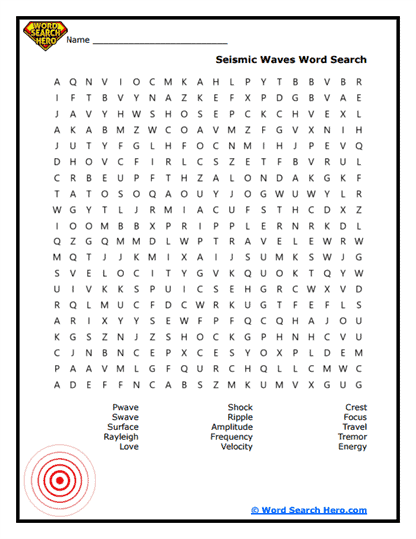
This word search is all about seismic waves and the essential terminology related to earthquakes and their vibrations. It includes various types of seismic waves (like P-wave, S-wave, Rayleigh, and Love), along with the features of wave activity such as amplitude, frequency, and velocity. It also includes terms that describe the results of seismic events […]

View More
Fault Frenzy Word Search

Fault Frenzy

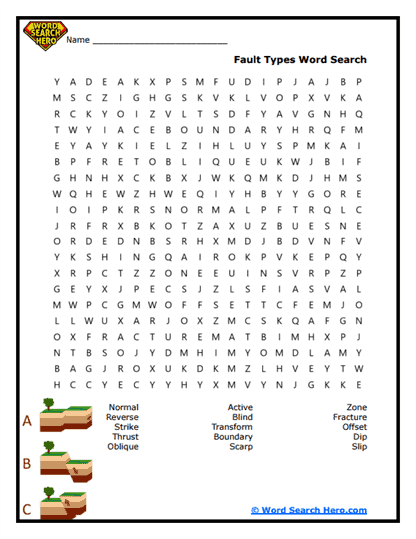
This word search explores the different types of geological faults and terms related to fault lines and tectonic movement. Words such as normal, reverse, strike, thrust, and oblique describe how fault blocks move during an earthquake. It also includes related scientific terms like transform, scarp, and boundary, which are commonly used when studying plate tectonics. […]

View More
Earthquake Effects Word Search

Earthquake Effects

The “Earthquake Effects” explores the various outcomes and physical impacts of an earthquake. Vocabulary terms like shaking, cracking, and collapse describe the immediate destruction caused. Other words like liquefy and rockfall focus on geological changes, while damage and rupture reflect the structural aftermath. This puzzle offers students a deeper understanding of the natural and human-made […]

View More
Tsunami Triggers Word Search

Tsunami Triggers

This worksheet focuses on the causes of tsunamis, helping students explore geological processes and movements beneath the sea. It includes terms such as quake, slip, uplift, and collapse, which explain how tectonic shifts initiate tsunami waves. Other words like trench, blast, and jerk give context to underwater disturbances. The vocabulary emphasizes the dynamic causes of […]

View More
Alert Action Word Search

Alert Action

This word search explores warning systems used to notify populations about seismic or tsunami threats. It includes technological and communication-related terms such as radar, buoy, sensor, and broadcast. Words like alert, monitor, and message reflect how information is sent out. Students learn about both the hardware and software involved in modern disaster alert systems. By […]

View More
Wave Wonders Word Search

Wave Wonders

This puzzle focuses on how ocean waves behave, especially during events like tsunamis or storm surges. Words like rise, runup, drag, and flow explain the movement of water. Others, like wavefront, crest, and speed, relate to wave structure and energy. Students use this worksheet to visualize and understand the dynamic behavior of ocean waves. Students […]

View More
Quake History Word Search

Quake History

This worksheet introduces students to some of the most historically significant earthquakes across the world. Locations like Chile, Nepal, and Mexico are paired with major quakes like Tohoku and Tangshan. The puzzle helps connect geography with historical seismic events, reinforcing awareness of global natural disasters. It’s a mix of earth science and global history. Searching […]

View More
Danger Zones Word Search

Danger Zones

This word search centers on geographic zones that are vulnerable to natural hazards. Words like coastal, valley, and island describe landforms at risk. Other terms like delta, faultline, and harbor highlight specific risk-related features. The vocabulary encourages spatial and environmental awareness in relation to seismic activity. As students search for each term, they sharpen their […]

View More
Safety Steps Word Search

Safety Steps

This worksheet provides terms related to earthquake and tsunami safety actions. It includes proactive steps like “drill,” “store,” and “evacuate” as well as emergency commands such as “drop” and “cover.” The vocabulary builds awareness around what to do before, during, and after a disaster. It emphasizes planning, sheltering, and reacting quickly. This search reinforces critical […]

View More
Fix-It Focus Word Search

Fix-It Focus

This puzzle highlights the various tools used to measure seismic activity and analyze data. Words such as seismograph, accelerometer, chart, and network describe instruments and systems used by scientists. Terms like cable, drum, and station reflect both digital and mechanical tools. This vocabulary is key to understanding how earthquakes are monitored. Students learn complex scientific […]

View More

About Our Earthquakes and Tsunamis Word Searches

Word searches are often underestimated-pigeonholed as simple vocabulary drills-but when used correctly, they’re a precise tool for reinforcing scientific language, pattern recognition, and conceptual categorization. In the study of earthquakes and tsunamis, where nearly every term is either specialized, misunderstood, or both, word searches can help learners build familiarity with technical language while visually identifying the architecture of complex ideas. This collection is designed not as an afterthought to instruction but as a deliberate immersion into the core terminology that underpins geophysics, disaster science, and wave mechanics.

Earthquake science begins with understanding how energy moves through the Earth. Seismic Shuffle focuses entirely on seismic waves-the physical signatures of an earthquake. It includes body waves (P-waves and S-waves), surface waves (Love and Rayleigh), and terms used to describe wave behavior, such as “amplitude,” “velocity,” and “frequency.” These are not interchangeable words; each represents a specific physical property that helps geologists interpret seismograms and reconstruct what happened deep underground. For example, P-waves arrive first but cause less damage; S-waves travel slower but with greater shearing motion. Rayleigh and Love waves are even slower, yet they account for much of the surface-level destruction. In short, these are the characters in the story of how Earth moves.

To understand why those waves happen at all, Fault Frenzy takes the next step by examining fault mechanics and structural geology. Every earthquake is rooted in the movement of rock masses along a fault plane. The puzzle includes terms such as “normal,” “reverse,” “strike,” and “thrust,” all of which describe different fault geometries and stress regimes. These aren’t just labels-they’re critical to earthquake forecasting. For example, thrust faults are especially dangerous near subduction zones where one tectonic plate is being forced under another. “Oblique,” “transform,” and “offset” describe the hybrid or lateral movements common at plate boundaries like the San Andreas Fault. Recognizing these patterns isn’t trivia; it’s essential to understanding which faults are most likely to rupture and how that rupture will propagate.

After movement comes consequence. Earthquake Effects gathers the terminology of what happens when stored elastic energy is released catastrophically. Words like “rupture,” “slide,” and “liquefy” aren’t just descriptors-they’re physical outcomes tied to well-understood mechanics. Soil liquefaction, for instance, occurs when saturated ground loses cohesion during shaking, which caused entire apartment buildings in the 1964 Niigata earthquake to tip like dominoes. The vocabulary here helps learners bridge cause and effect-how a seismic event physically reshapes the environment, from microfractures to full-scale collapses.

Not every earthquake causes a tsunami, but every tsunami of tectonic origin begins with an undersea disruption. Tsunami Triggers isolates the vocabulary related to sudden ocean floor displacements. This includes vertical motion-“uplift,” “slip,” “drop”-as well as secondary triggers like “eruption” or “blast.” “Trench” and “fault” anchor these terms in tectonic geography. The specificity of these words matters. Not all undersea earthquakes cause tsunamis; only those that generate significant vertical displacement of the water column are capable of it. Including “jerk” isn’t humorous-it’s technically accurate. The “jerk parameter” in seismology quantifies the rate of acceleration, which can influence the initial tsunami waveform.

Wave Wonders moves beyond initiation to propagation. It covers how energy travels through water in the form of long-period tsunami waves. “Runup” refers to the maximum vertical height the water reaches onshore, while “drawback” is the often-misunderstood retreat of water that can precede a major wave. “Wavefront,” “speed,” and “height” are central to tsunami modeling, especially when projecting landfall scenarios. The vocabulary also touches on dynamic forces-“drag,” “push,” “force”-that make these waves so destructive. Unlike surface wind waves, which involve localized energy at the ocean’s surface, tsunami waves displace the entire water column from seafloor to surface. That’s why they travel faster than a commercial jetliner and can pass unnoticed in deep water until they encounter a continental shelf.

Science alone doesn’t mitigate disasters-data and communication do. Alert Action dives into the engineering and systems that support early warning. “Sensor,” “gauge,” and “buoy” describe physical instrumentation; “broadcast,” “monitor,” and “signal” track how information moves. One surprising fact: the DART (Deep-ocean Assessment and Reporting of Tsunamis) system uses pressure sensors on the seafloor and satellites to detect changes in water column height of just a few centimeters across hundreds of kilometers. That data has saved thousands of lives. Teaching this vocabulary isn’t just about technical literacy-it’s about understanding the infrastructure of global disaster resilience.

To add depth to conceptual learning, Quake History collects names of major seismic events that helped redefine scientific understanding. The 1960 Valdivia earthquake in Chile remains the strongest ever recorded (Mw 9.5), while the 2011 Tohoku quake caused the Fukushima nuclear disaster. Each event reflects a breakthrough in how scientists model tectonics, assess building safety, or evaluate tsunami risk. Terms like “Lisbon” and “Tangshan” are not just historical-they’re scientific milestones. For instance, the 1755 Lisbon earthquake led to the development of the first seismic hazard maps and shook the foundations of Enlightenment thinking in Europe, both literally and philosophically.

Spatial risk matters. Danger Zones compiles geographic descriptors-“delta,” “faultline,” “coastal,” “urban”-that help students analyze risk landscapes. These aren’t generalizations. For example, coastal deltas are particularly vulnerable because of high population density, soft sediment, and proximity to subduction zones. “Basin” and “slope” affect the way seismic waves amplify or dampen. Mexico City, for instance, sits on a dried lakebed that acts like a bowl, intensifying ground motion during quakes. Vocabulary in this puzzle can support spatial reasoning activities and risk mapping exercises, linking physical geography to seismic vulnerability.

Behavioral science is also part of disaster response. Safety Steps introduces vocabulary around preparation and protective action-“drop,” “cover,” “evacuate,” “shelter,” and “brace.” These are more than drills. Rapid motor memory of these actions correlates strongly with survival outcomes in real seismic events. The word “signal” here bridges back to alert systems; “plan” and “store” anchor long-term preparation. Including “wait” and “listen” may seem passive, but they reflect the real pacing of post-event survival in areas awaiting aftershocks or delayed tsunami waves.

Understanding how we measure seismic activity closes the conceptual loop. Fix-It Focus includes tools and terms such as “seismograph,” “accelerometer,” “network,” and “chart.” Each is foundational to modern earthquake science. Seismometers don’t just detect quakes-they can determine magnitude, depth, and mechanism. Arrays of sensors form global networks that provide real-time data used by institutions like the USGS and Japan Meteorological Agency. “Drum,” “cable,” and “station” reflect both analog history and the still-essential infrastructure of seismic monitoring.