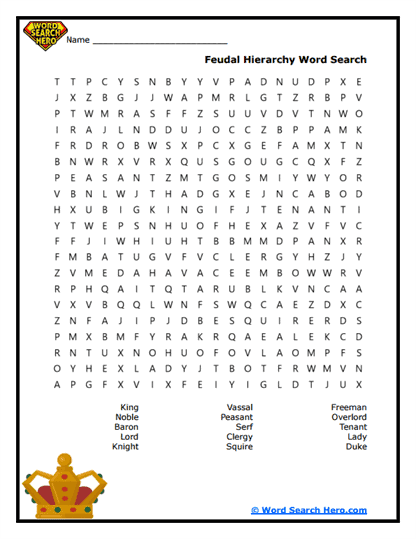
About Our Feudalism Word Searches
Our Feudalism Word Searches introduce students to one of the most important systems that shaped life in medieval Europe while helping them build vocabulary, spelling, and focus skills. These printable puzzles highlight the key roles, relationships, and institutions connected to feudal society during the Middle Ages.
Teachers often use word searches as simple yet effective tools for reinforcing historical vocabulary. As students search for words related to kings, lords, knights, and peasants, they become more familiar with the language used in lessons about medieval government and social structure. Repeated exposure to these terms helps learners recognize them more easily when reading textbooks or discussing historical topics in class.
Parents and homeschool educators also appreciate activities that combine learning with entertainment. Word searches encourage patience, visual scanning, and attention to detail while quietly reinforcing important historical concepts. While students search through the puzzle grid, they are interacting with meaningful vocabulary connected to the way medieval society was organized.
Feudalism is an especially interesting topic because it explains how land, loyalty, and protection shaped relationships between different groups of people. Students may encounter words related to castles, land ownership, military service, and farming communities.
By exploring these terms through puzzles, learners begin to understand how medieval societies operated and how different roles within the feudal system depended on one another. These word searches provide a fun and accessible introduction to one of the defining systems of the Middle Ages.
Lords, Knights, and the Structure of Feudal Society
Feudalism was a social and political system that organized much of medieval European society. At its core, feudalism was based on relationships involving land, loyalty, and protection.
At the top of the system was the king, who controlled large territories. Because it was difficult to govern such large areas alone, the king granted land to powerful nobles known as lords. In return, these lords promised loyalty and support, especially during times of war.
Lords often divided their land further by granting portions to knights or other vassals. These individuals pledged to serve their lord, often providing military protection when needed. Knights were trained warriors who defended their lord’s territory and helped maintain order.
At the base of the system were peasants and farmers, who worked the land and produced food. Many lived in small villages located on estates called manors. In exchange for protection and the right to farm the land, peasants provided labor and a share of their crops to the local lord.
Students often find it helpful to see feudalism as a network of responsibilities connecting different levels of society. Each group depended on the others to maintain stability and security.
Learning these roles through word search puzzles helps students become familiar with the vocabulary associated with medieval society and understand how the feudal system functioned.
Paul’s Pro-Tip
One of my favorite ways to use feudalism puzzles is what I call the “who depends on who?” challenge.
After students finish the word search, ask them to find words connected to three different roles in the feudal system-maybe king, knight, and farmer.
Then ask: How do these people depend on each other?
Students quickly start building the chain. The king grants land to the lords, the knights defend the land, and the farmers produce the food that supports everyone.
It turns a simple puzzle into a quick lesson on how medieval society was structured.
Why Feudalism Helped Organize Medieval Communities
Feudalism developed during a time when strong central governments were rare and communities needed ways to maintain order and security. With limited communication and transportation, rulers often relied on local leaders to manage and protect different regions.
The feudal system helped solve this problem by creating layers of responsibility. Kings granted land to trusted nobles, who then oversaw local territories. These nobles worked with knights and other vassals to protect their lands and maintain stability.
Manors became the center of local life within this system. These estates included farmland, villages, and sometimes a castle or fortified residence. Most peasants lived and worked on these lands, producing the crops and resources needed to support the community.
Although the system created stability in some areas, it also led to strong social divisions. Opportunities for mobility were limited, and many people remained in the same roles throughout their lives.
Students often find it interesting that feudalism was not just about government-it also shaped economics, agriculture, military service, and everyday life. Word searches featuring vocabulary connected to these ideas help reinforce the language used when studying medieval society.
Through repeated exposure to these terms, learners begin to recognize how feudal relationships organized communities across much of medieval Europe.
Frequently Asked Questions
What was feudalism?
Feudalism was a system used in medieval Europe where land ownership, loyalty, and protection connected different levels of society, including kings, nobles, knights, and peasants.
How can teachers use feudalism word searches in class?
Teachers often use them as bell ringers, vocabulary reinforcement activities, or early finisher assignments during units on medieval history.
What grade levels are these puzzles best for?
They work well for upper elementary and middle school students studying the Middle Ages, though they can also be useful review tools for older learners.
Are these puzzles useful for homeschool history lessons?
Yes. Homeschool families frequently use printable word searches as independent learning activities that reinforce vocabulary and keep students engaged.
What extension activity works well after completing the puzzle?
Students can choose several words from the puzzle and explain how those roles or ideas connect within the feudal system. This encourages deeper thinking about how medieval society functioned.