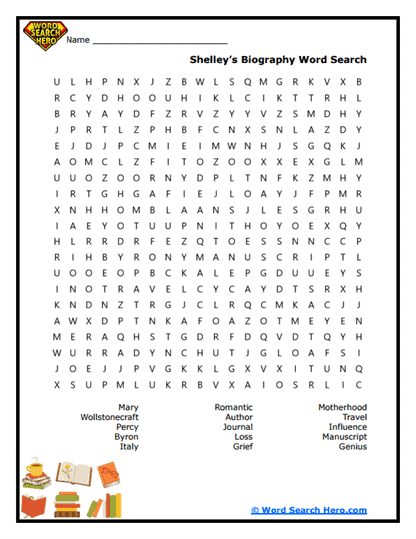
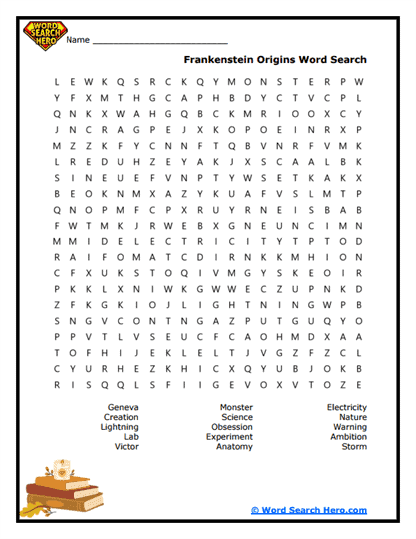
About Our Mary Shelley Word Searches
Our Mary Shelley Word Searches help students explore the work of one of the most important early authors of science fiction and gothic literature while strengthening vocabulary, spelling, and concentration skills. These printable puzzles introduce learners to the characters, themes, and ideas connected to Shelley’s most famous novel and her lasting influence on literature.
Teachers often look for engaging ways to reinforce literary knowledge, and word searches provide a simple and effective option. As students search for words related to Mary Shelley’s stories, scientific ideas, and gothic themes, they become more familiar with the vocabulary associated with classic speculative fiction. Repeated exposure to these terms helps learners recognize them more easily when studying early science fiction and romantic-era literature.
Parents and homeschool educators also appreciate activities that combine learning with entertainment. Word searches encourage visual scanning, patience, and attention to detail while quietly reinforcing reading-related concepts. Students interact with vocabulary connected to invention, responsibility, imagination, and the consequences of human ambition.
Mary Shelley’s writing remains influential because it combines suspenseful storytelling with powerful questions about science and morality. Through these puzzles, students gain an engaging introduction to the vocabulary associated with one of the most important pioneers of science fiction.
The Author of Frankenstein
Mary Shelley was an English writer born in 1797 who became famous for writing the novel Frankenstein; or, The Modern Prometheus. She wrote the book when she was very young, and it quickly became one of the most famous works of gothic and science fiction literature.
Frankenstein tells the story of a scientist named Victor Frankenstein, who creates a living creature through scientific experimentation. However, he becomes frightened by the results of his work and abandons the being he has brought to life.
The story explores the consequences of scientific ambition and raises questions about responsibility, compassion, and the relationship between creators and their creations. Although the creature is often misunderstood, the novel invites readers to consider deeper questions about humanity and ethical choices.
Shelley’s novel is known for combining elements of gothic horror, philosophical reflection, and early science fiction. Her imaginative idea of creating life through science influenced many later stories about scientific discovery and its possible dangers.
Students studying Mary Shelley often discover how literature can explore both exciting ideas and serious questions about human responsibility.
Paul’s Pro-Tip
After students finish the word search, try a quick “science and responsibility” discussion.
Ask them to circle one scientific idea and one character name from the puzzle.
Then ask: Should inventors always think about how their inventions might affect others?
Students often begin discussing technology, ethics, and responsibility. It’s a great opportunity to show how stories like Frankenstein explore questions that still matter today.
Sometimes a fictional story can start a very real conversation.
Why Mary Shelley’s Writing Is So Influential
Mary Shelley’s novel Frankenstein helped establish many of the ideas that later became central to science fiction. The story explores what might happen when scientific discovery goes too far or when inventors fail to consider the consequences of their work.
Her novel also reflects the intellectual curiosity of the early 19th century, a time when scientific discoveries were rapidly expanding. Shelley imagined how those discoveries might affect society, which made her story both imaginative and thought-provoking.
Over time, Frankenstein became one of the most widely recognized stories in literature. The characters and themes have appeared in countless films, plays, and adaptations across many forms of media.
The novel also continues to influence discussions about science, ethics, and technology. Questions raised in the story-about responsibility, creation, and the treatment of others-still resonate with modern readers.
Word searches featuring vocabulary connected to Mary Shelley help reinforce the characters, themes, and ideas students encounter when studying classic gothic and science fiction literature. By recognizing these words repeatedly, learners gain a clearer understanding of why Shelley’s work remains one of the most important and widely discussed novels in literary history.
Frequently Asked Questions
Who was Mary Shelley?
Mary Shelley was an English author best known for writing Frankenstein, a novel that helped shape early science fiction and gothic literature.
What is Frankenstein about?
The story follows Victor Frankenstein, a scientist who creates a living being through experimentation and must face the consequences of his actions.
Why is Mary Shelley important to literature?
Her novel Frankenstein helped introduce themes that became central to science fiction, especially the relationship between science, ethics, and responsibility.
How can teachers use Mary Shelley word searches in class?
Teachers often use them as warm-up activities, vocabulary reinforcement exercises, or introductions to discussions about science fiction and gothic literature.
What extension activity works well after completing the puzzle?
Students can discuss or write about a modern invention and consider both the benefits and possible consequences of that technology.