Choose a topic !

Meteor Showers Word Searches

Shower Stars Word Search

Shower Stars

This word search focuses on the names of famous meteor showers observed throughout the year. Students are tasked with finding names such as “Perseids,” “Leonids,” and “Draconids” hidden in the grid. These names correspond to different meteor showers that occur at specific times and originate from different constellations. Completing this puzzle helps students recognize astronomical […]

View More
Meteor Parts Word Search

Meteor Parts

This worksheet delves into the anatomy of a meteor, highlighting its physical structure and components. Students search for terms like “core,” “fragment,” “trail,” and “plasma” that describe the different features and transformations of a meteor as it travels through space and the atmosphere. The vocabulary emphasizes the various scientific stages from cosmic rock to a […]

View More
Origin Trail Word Search

Origin Trail

This word search explores the origins of meteor showers, focusing on space-related elements and how showers begin. Vocabulary such as “comet,” “asteroid,” “trail,” and “ejecta” helps students learn about the source objects and paths that lead to meteor showers visible from Earth. Other terms like “debris,” “object,” and “parent body” provide insight into the fragmentation […]

View More
Entry Impact Word Search

Entry Impact

This worksheet focuses on vocabulary related to a meteor’s entry into Earth’s atmosphere. Terms such as “friction,” “compression,” “shockwave,” and “ionization” highlight the physical and thermal forces acting on a meteor. Students also encounter descriptive words like “glow,” “burst,” and “trajectory,” providing insight into what occurs during atmospheric entry. These words reflect the energetic journey […]

View More
Viewing Tools Word Search

Viewing Tools

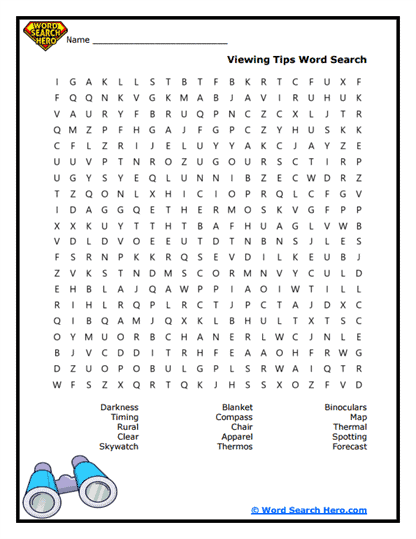
This word search highlights the tools, tips, and conditions needed to successfully view a meteor shower. Vocabulary such as “binoculars,” “map,” “compass,” and “thermal” help students learn how to prepare for stargazing events. Other words like “blanket,” “apparel,” and “forecast” focus on comfort and planning, ensuring a safe and enjoyable experience. The puzzle connects practical […]

View More
Sky Wonders Word Search

Sky Wonders

This word search explores the different visual phenomena associated with meteor activity and night sky observation. Words like “bolide,” “fireball,” “twinkle,” and “zodiacal” describe unique sights and astronomical events. Terms such as “glow,” “trail,” and “radiant” reflect the beauty and complexity of celestial happenings. The activity teaches students to identify and understand descriptive and scientific […]

View More
Frequency Tracker Word Search

Frequency Tracker

This word search focuses on the timing and frequency patterns of meteor showers. It includes vocabulary such as “annual,” “peak,” “flux,” and “duration,” which help students understand how often and for how long meteor showers occur. Words like “interval,” “cycle,” and “window” give insight into the scientific planning and prediction of these events. This puzzle […]

View More
Science Words Word Search

Science Words

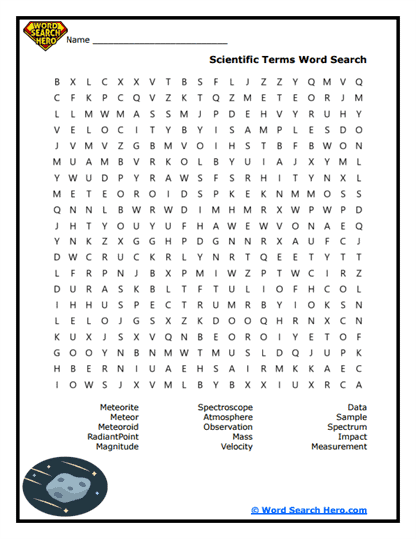
This worksheet presents scientific vocabulary related to meteors, meteorites, and the tools used to study them. Words like “meteorite,” “mass,” “velocity,” and “spectroscope” encourage students to explore the tools and concepts behind astronomical observation. Additional terms such as “data,” “impact,” and “measurement” reinforce STEM-based learning. This search integrates physical science with analytical terminology, ideal for […]

View More
Cosmic Canvas Word Search

Cosmic Canvas

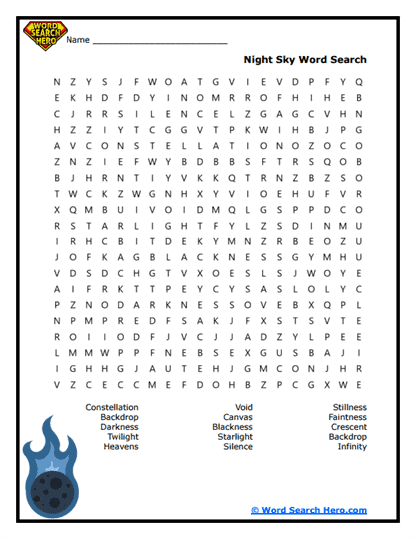
This word search explores poetic and descriptive terms associated with the night sky. Words like “constellation,” “void,” “twilight,” and “infinity” capture the vastness and beauty of space. Other words such as “stillness,” “blackness,” and “canvas” evoke a sense of calm and mystery. The vocabulary connects scientific ideas with literary expression, allowing students to experience astronomy […]

View More
Belief Wishes Word Search

Belief Wishes

This word search explores cultural and spiritual beliefs surrounding meteor showers. It includes words like “wishing,” “luck,” “prayer,” and “tradition” to show how different societies have interpreted celestial events. Other words like “legend,” “symbol,” and “meaning” highlight the symbolic significance of meteors. This puzzle provides a cross-cultural perspective, blending vocabulary with mythology and belief systems. […]

View More

About Our Meteor Showers Word Searches

Meteor showers are not just visual phenomena-they are intersections of orbital mechanics, thermal physics, atmospheric chemistry, and planetary geology. These word searches are built to reflect that complexity. Each puzzle isolates a domain within meteor science and astronomy, using vocabulary not as filler, but as entry points into structured, scientific understanding. Every word on the grid represents a concept worth knowing, a mechanism worth exploring, or a dataset worth collecting.

Scientific literacy depends heavily on familiarity with specialized vocabulary. That vocabulary can be a barrier or a bridge. This collection is designed to turn it into the latter. As students locate terms like “ejecta,” “spectroscope,” or “flux,” they are repeatedly exposed to core concepts that underlie meteor research. This repetition trains recognition, sharpens spelling, and builds neural familiarity with domain-specific language, all while reinforcing broader reading skills.

The puzzle Shower Stars concentrates on the naming system used in observational meteor astronomy. Meteor showers are named after the constellations from which their radiants appear to emerge. This naming convention is not poetic; it’s a direct result of Earth’s orbital trajectory intersecting with debris fields left by comets or, in rarer cases, asteroids. Terms like “Geminids” and “Quadrantids” carry temporal and spatial meaning. These showers reoccur annually because the parent body’s orbit and Earth’s orbit align on a predictable schedule. Learning the names is equivalent to learning a calendar of spaceborne intersections.

Origin Trail focuses on the parent bodies of meteor showers-often ancient, dusty comets with elliptical orbits-or sometimes extinct comets that have collapsed into rockier, asteroid-like forms. The words in this puzzle reflect the disintegration pathways that create persistent debris streams. The term “duststream,” for example, connects directly to the trails of particulate matter that intersect Earth’s orbit. “Ejecta” and “coma” are relevant for describing the material released during solar heating. Every word here contributes to building a model of how dynamic, decaying bodies generate predictable meteor activity.

The anatomy and transformation of meteoroids are the subjects of Meteor Parts. Terms like “plasma” and “core” are essential to understanding what happens when a space rock enters Earth’s atmosphere at hypersonic speeds. The process is not simple combustion; it’s compression heating of atmospheric gases, ionization of surface particles, and rapid mass loss via ablation. Words like “trail,” “fragment,” and “shimmer” point to visible phenomena created by those underlying physical processes. Collectively, the vocabulary builds a layered understanding of how energy transfer, material phase change, and high-velocity kinetics produce meteors.

The mechanics of entry are detailed further in Entry Impact, where words like “shockwave,” “ionization,” and “incandescence” highlight the thermodynamic violence of atmospheric transit. A meteoroid hitting the atmosphere at tens of kilometers per second generates temperatures exceeding 3,000ยฐC. Ionization of the surrounding air results in a plasma sheath, leading to visible luminosity-the “shooting star” effect. This puzzle’s vocabulary focuses on energetic transformation, emphasizing how invisible objects in space become observable events due to their interaction with Earth’s gaseous envelope.

Understanding meteor events is not limited to their cause or structure. Observing them requires tools, environmental conditions, and planning. Viewing Tools collects terms associated with real-world observational readiness. “Binoculars” and “thermal” relate to human sensory limitations and how we extend them with technology. “Forecast,” “skywatch,” and “clear” highlight the dependence of visual astronomy on atmospheric transparency and light pollution levels. Every observational success depends not just on celestial alignment, but on terrestrial preparedness.

Frequency Tracker tackles periodicity and statistical regularity. Meteor showers have quantifiable attributes: flux rates (meteors per hour), peak dates, active durations, and recurrence intervals. These are measurable, analyzable, and predictable. Words like “cycle,” “flurry,” and “return” map to mathematical properties of meteor activity. “Flux” and “duration” could as easily appear in a scientific paper or software dashboard as they do in a classroom puzzle. This puzzle reinforces temporal reasoning and statistical thinking as applied to orbital dynamics and debris field density.

The focus shifts from observational setup to observational outcomes in Sky Wonders. Terms like “fireball,” “bolide,” and “zodiacal” describe specific classifications and related luminous phenomena. A bolide, for instance, is a fireball that explodes in the atmosphere, often accompanied by sonic booms. “Zodiacal” connects to zodiacal light, a diffuse glow created by sunlight reflecting off interplanetary dust, some of which originates from disintegrated meteor streams. These words bring nuance to the experience of skywatching, anchoring spectacle to classification.

Science Words supports conceptual consolidation. Its vocabulary reinforces the analytical methods and tools used to study meteors, meteoroids, and meteorites. Terms like “spectroscope,” “velocity,” and “magnitude” align with the observational and computational sciences. “RadiantPoint” refers to the calculated apparent origin of a meteor stream, and “spectrum” relates to the emission and absorption lines produced during atmospheric entry. These are not metaphorical terms-they are measurable features that allow for object classification, trajectory prediction, and compositional analysis.

Cosmic Canvas introduces a shift in context while maintaining scientific relevance. The words here evoke the perception and scale of the sky as an environment-a blackbody, a radiative medium, a cultural constant. “Constellation” connects to navigation and sky mapping; “void,” “twilight,” and “starlight” are perceptual descriptors with photometric implications. This puzzle reinforces that astronomical vocabulary also includes terms that bridge observation and interpretation, rooted in human perception of astronomical scales and contrast.

In Belief Wishes, vocabulary traces the anthropological side of meteor showers. Words like “omen,” “tradition,” and “legend” reflect the embeddedness of celestial events in folklore and cultural memory. While not empirically explanatory, these words represent historical frameworks for interpreting meteors before scientific explanation was available. Including this puzzle acknowledges that science does not operate in a cultural vacuum, and that understanding public perception of astronomical events is essential for science communication.