Choose a topic !

Redox Reactions Word Searches

Oxidation Quest Word Search

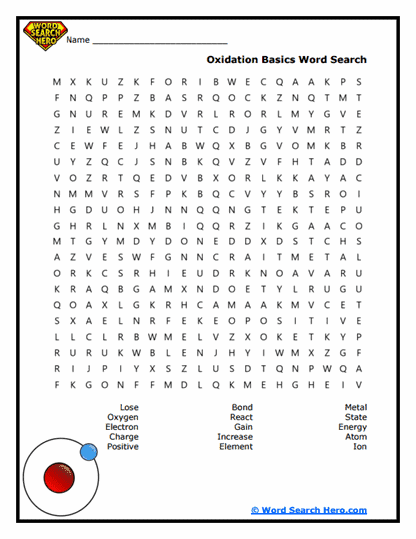
Oxidation Quest

This word search centers on the fundamentals of oxidation. Students will encounter vocabulary related to how atoms interact during oxidation, such as “lose,” “electron,” “charge,” and “metal.” The terminology reflects key concepts like changes in oxidation state, element transformation, and bonding. Completing this puzzle helps reinforce understanding of oxidation as a chemical process. Working on […]

View More
Reduction Dive Word Search

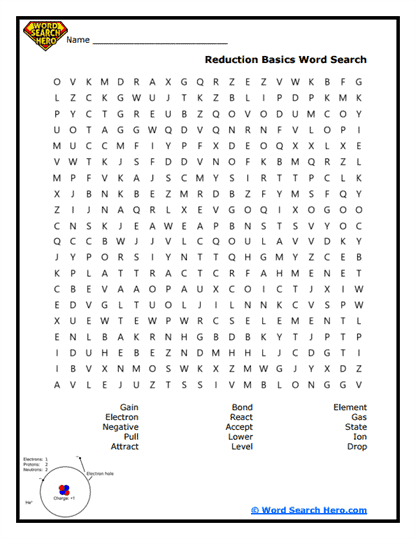
Reduction Dive

This puzzle explores the key ideas involved in reduction reactions. Words like “gain,” “electron,” “accept,” and “lower” reflect the nature of chemical reduction and how it differs from oxidation. This search emphasizes vocabulary about energy transfer, charge changes, and the concept of pulling or attracting electrons. It ties into the broader redox reaction framework by […]

View More
Number Charge Word Search

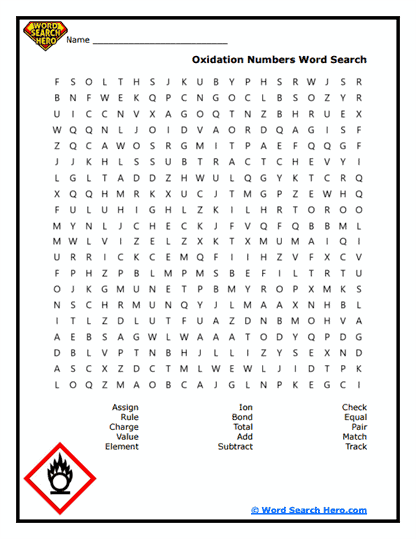
Number Charge

This word search is focused on oxidation numbers and how they are used in chemical equations. Students will learn to identify and understand terms like “assign,” “charge,” “subtract,” and “rule” as they apply to calculating and interpreting oxidation states. It integrates arithmetic operations like add and subtract with chemical language. This makes it a crossover […]

View More
Electron Path Word Search

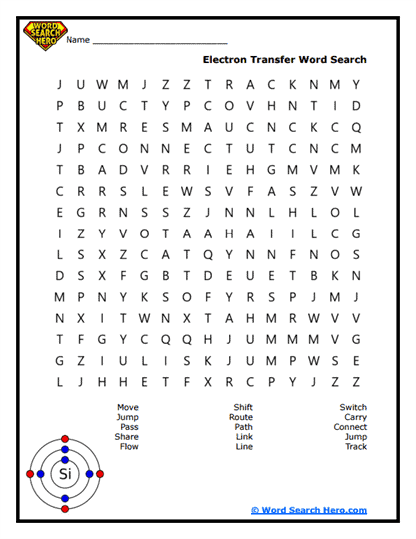
Electron Path

This search centers around the movement of electrons, especially during bonding and chemical reactions. Students will find action-related terms such as “move,” “jump,” “carry,” and “connect,” reflecting the dynamic nature of electrons in redox reactions. It visually and conceptually introduces the flow of charge and energy transfer between atoms. By hunting for words that describe […]

View More
Agent Match Word Search

Agent Match

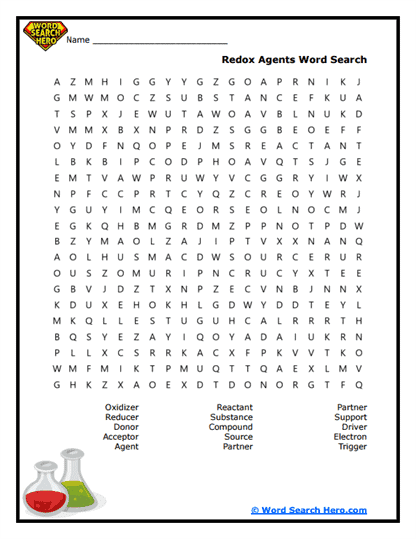
This worksheet dives into the roles of redox agents-oxidizers and reducers-in chemical reactions. It includes words like “donor,” “acceptor,” “reactant,” and “compound,” emphasizing how substances contribute to electron transfer. This vocabulary builds understanding of the components driving redox reactions. Engaging with these terms enhances conceptual clarity on how redox reactions operate. It supports vocabulary retention […]

View More
Daily Redox Word Search

Daily Redox

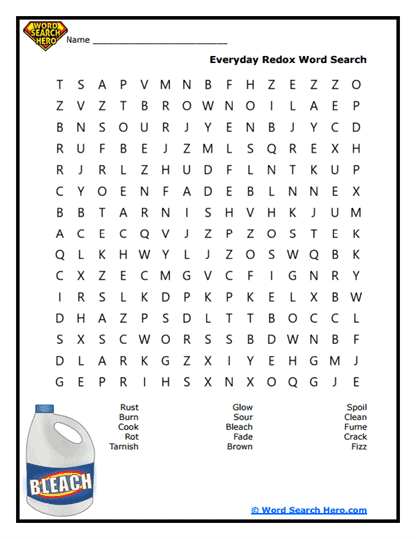
This word search introduces redox concepts found in daily life. Words like “burn,” “rust,” “cook,” and “tarnish” help students see the practical applications of oxidation and reduction. This worksheet connects classroom science to real-world experiences, reinforcing relevance and familiarity. Students expand their vocabulary by associating common phenomena with scientific processes. It builds comprehension through real-life […]

View More
Equation Builder Word Search

Equation Builder

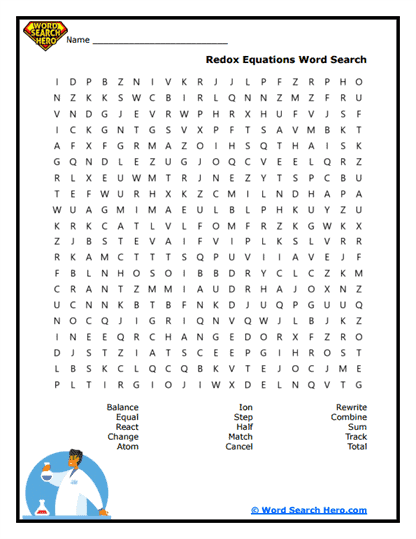
This puzzle focuses on the structure and balance of redox equations. Key words like “balance,” “react,” “equal,” and “cancel” highlight the process of ensuring chemical reactions follow conservation laws. It teaches students the vocabulary of precision and logical structure in chemistry. This worksheet supports deeper understanding of how redox equations are written and balanced. It […]

View More
Half Split Word Search

Half Split

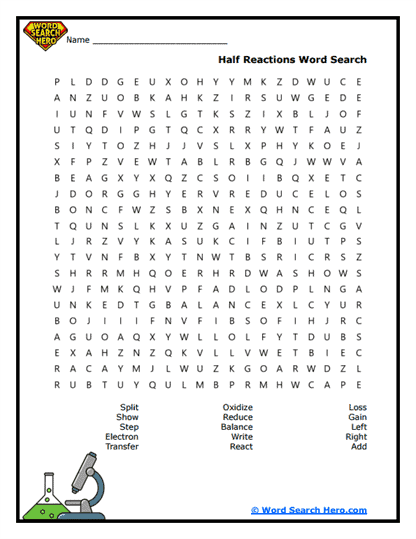
This word search introduces the concept of half-reactions in redox chemistry. Words like “oxidize,” “reduce,” “split,” and “transfer” represent how redox reactions are broken into separate oxidation and reduction steps. This worksheet isolates and emphasizes the logic of dividing complex reactions into simpler components. The puzzle enhances understanding of detailed chemical processes through strategic vocabulary […]

View More
Rust Trail Word Search

Rust Trail

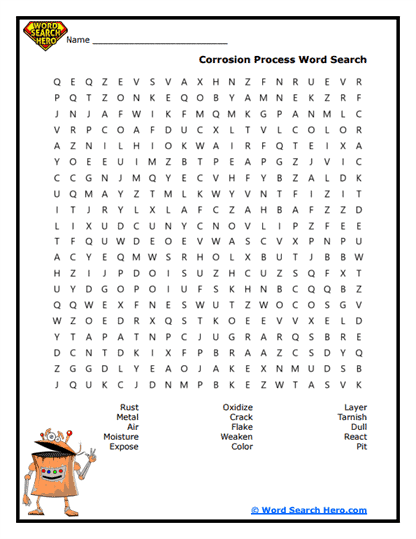
This worksheet is all about corrosion-how metals degrade over time due to redox reactions. Words such as “moisture,” “air,” “oxidize,” and “flake” guide students in understanding what causes rust and how it progresses. The vocabulary reflects both physical changes and chemical concepts related to corrosion. Students connect visual and tactile experiences (like rusting metal) with […]

View More
Industry Sparks Word Search

Industry Sparks

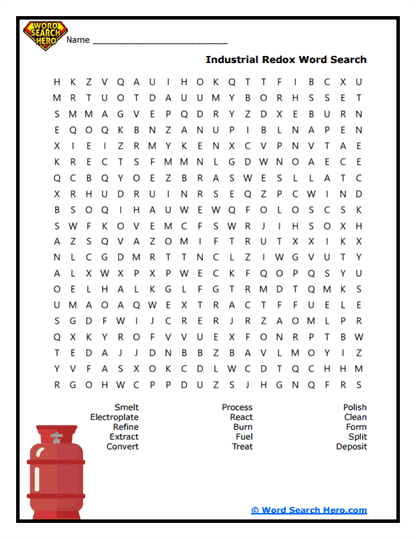
This puzzle focuses on how redox reactions are used in industrial applications. Students explore vocabulary like “smelt,” “burn,” “refine,” and “deposit,” which are linked to manufacturing, metallurgy, and chemical processing. It emphasizes functional and technical uses of redox reactions in technology and industry. The activity strengthens technical vocabulary and introduces industrial applications of chemistry. It […]

View More

About Our Redox Reactions Word Searches

Redox reactions are fundamental to chemistry-not as a niche or a special topic, but as a recurring theme that governs how matter changes at the most elemental level. These puzzles are designed to support science learners in exploring the vocabulary of redox in a hands-on, spatially engaging way. They are not filler activities. They are tools for internalizing terminology that underpins everything from metabolism to metallurgy.

The aim here isn’t just to recognize isolated words but to internalize how those terms connect. In chemistry, language is inseparable from structure. Terms like oxidation, electron, and ion aren’t abstract-they’re shorthand for the rearrangement of particles that defines chemical identity and behavior. In redox chemistry specifically, electrons are tracked like currency. Knowing who loses them, who gains them, and what the consequences are-this is the discipline of redox, and this is what this collection introduces.

The first group of puzzles is built around the core dynamics of electron transfer, the essence of what defines oxidation-reduction reactions. Oxidation Quest focuses on the loss of electrons, which is more than a mechanical detail-it’s a shift in the fundamental character of an atom. Oxidation alters how atoms bond, how energy is stored or released, and how compounds interact. Reduction Dive explores the inverse: the gain of electrons. Reduction reactions are not just complementary-they are interdependent. There is no oxidation without reduction, no electron loss without electron gain. That reciprocity is the defining feature of redox. Electron Path goes deeper into this movement itself, highlighting the spatial and energetic pathways electrons take. Whether shared, shifted, or passed entirely, the trajectory of electrons determines the direction, feasibility, and energy profile of redox processes.

To use redox principles in analysis or calculation, learners need tools to track quantitative change. That’s the focus of the puzzles in the quantification and rule structure group. Number Charge introduces the system of oxidation numbers, which is not a set of arbitrary rules, but a bookkeeping method grounded in electronegativity and bonding logic. These values allow chemists to determine where electrons have gone and which atoms have changed. In Equation Builder, those abstract ideas are applied to full reaction balancing. Students confront vocabulary tied to conservation principles-mass and charge must balance, and half-reactions must coordinate. Redox equations are not written by guesswork; they are constructed by rules that emerge from consistent electron accounting. These puzzles help instill that procedural thinking.

Beyond the theoretical and computational aspects, redox reactions are observable in the world. They’re not hidden-they manifest in visible, tactile, and industrial processes. The applied and environmental group captures these expressions. Daily Redox maps out reactions encountered constantly: food spoiling, metals discoloring, fuels burning. These are all redox events, often accelerated by environmental exposure. Chemistry is not confined to labs-it unfolds on stovetops and sidewalks. Rust Trail brings attention to corrosion, a particularly slow but structurally significant redox pathway. In corrosion, metals transition to more stable oxidized forms, driven by moisture, oxygen, and time. The damage it causes is costly and constant; this is redox operating on infrastructure. Industry Sparks focuses on deliberate applications-how redox principles are used in refining ores, electroplating components, and processing fuels. These are not accidents of nature. They’re engineered transformations, guided by careful manipulation of redox behavior.

Understanding redox also means understanding roles and mechanisms, which are addressed in the final group. Agent Match presents the vocabulary of reactivity roles. Oxidizing agents accept electrons; reducing agents donate them. These agents don’t just participate-they determine the outcome of the reaction. The identity and strength of these agents affect whether a reaction occurs spontaneously, whether energy is released or consumed, and what products are formed. Half Split breaks the process down to its functional halves. Every redox reaction can be dissected into two half-reactions-one for oxidation, one for reduction. This conceptual split allows chemists to isolate mechanisms, understand energy flow, and apply electrochemical techniques like voltmetry and electrolysis. Without this decomposition, redox chemistry becomes opaque. With it, redox becomes not only solvable but predictable.

Each word search in this collection reinforces a critical aspect of redox chemistry. Students see terms not just in isolation but in context, repeatedly, in proximity to related ideas. This repetition matters. Scientific vocabulary is dense because it carries meaning. Every term in these puzzles maps to an underlying process: gain, ion, electron, smelt, oxidizer. These aren’t just words to memorize-they’re cues to mechanisms that drive physical change. The more fluently a learner can move through these terms, the more easily they can think in chemical frameworks.

In chemistry, language shapes thought. Every word you circle here maps to something measurable, definable, and, in many cases, observable. This isn’t peripheral vocabulary-it’s core content. Mastering this language leads to mastery of the concepts. Redox is not a side note in chemistry; it is one of the primary ways that matter transforms. These puzzles give learners access to that transformation-term by term, reaction by reaction.