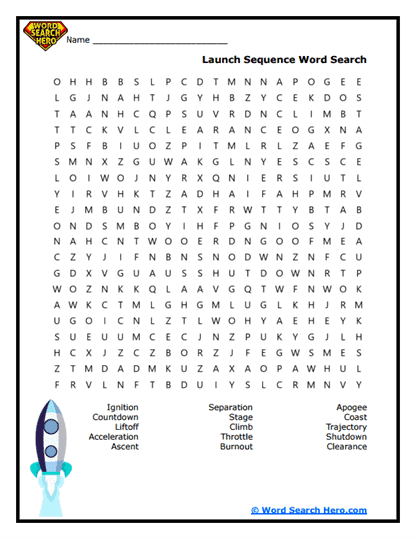
About Our Rocket Ship Word Searches
Rocket Ship word searches introduce students to the vocabulary used to study rockets, spacecraft, and the technology that allows humans to travel beyond Earth. These printable puzzles help learners become familiar with scientific terms related to launches, propulsion, space missions, and the engineering behind rocket flight. Before students explore rocketry and space exploration in depth, it often helps to first recognize the language scientists and engineers use to describe how rockets work.
Students studying rocket ships may encounter words such as rocket, launch, propulsion, booster, engine, fuel, and spacecraft. These terms frequently appear in space science and engineering lessons and help students understand how rockets generate the power needed to escape Earth’s gravity and travel into space. A word search provides an engaging way to reinforce this vocabulary while strengthening reading, spelling, and observation skills.
Because the activity feels like a puzzle rather than a traditional worksheet, it can make science and engineering vocabulary easier and more engaging to learn. Teachers often use these printables during science centers, independent practice, review sessions, or early finisher activities. Parents and homeschool educators can also include them in lessons as a way to introduce rocketry vocabulary in an interactive format.
As students search for the words in the puzzle grid, they strengthen concentration, visual scanning, and pattern recognition skills. At the same time, they build familiarity with the terminology used when studying rockets and spaceflight technology.
Understanding Rocket Ships
A rocket ship is a vehicle designed to travel into space by producing thrust through powerful engines. Rockets work by pushing exhaust gases downward at high speed, which creates an upward force that lifts the rocket into the air.
Rocket launches require enormous amounts of energy because the vehicle must overcome Earth’s gravity. To achieve this, rockets often use multiple stages. Each stage contains engines and fuel that are used during a specific portion of the flight. When a stage finishes burning its fuel, it separates from the rocket, making the remaining spacecraft lighter and more efficient.
Rockets carry a variety of payloads into space. These payloads may include satellites, scientific instruments, cargo supplies, or astronauts traveling to space stations or beyond.
Modern rockets are used for many purposes, including launching communication satellites, exploring other planets, and supporting human space missions.
Learning the vocabulary associated with rocket ships helps students understand how engineers design vehicles capable of traveling beyond Earth’s atmosphere.
Word searches reinforce this learning by giving students repeated exposure to the key terms used when studying rocket launches and space missions.
Paul’s Pro-Tip
A powerful extension activity is a “build and test a paper rocket” challenge. After students complete the word search, have them construct simple rockets using paper, straws, or lightweight materials.
Students can experiment with different rocket shapes, fin sizes, and nose designs to see how these features affect how far or how straight the rocket travels when launched by blowing through a straw or using a simple launcher.
Encourage students to record their results and identify which design worked best. This activity helps introduce the idea that engineers test and refine rocket designs through experimentation.
Helping Students Understand Spaceflight Technology
Rocket ships are essential tools for exploring space and placing satellites into orbit around Earth. Without rockets, scientists would not be able to send spacecraft to other planets or launch telescopes that observe the universe.
Understanding rocket vocabulary helps students interpret diagrams of spacecraft, news about space missions, and discussions about space exploration. These ideas also connect to broader topics such as engineering, physics, propulsion systems, and planetary exploration.
A word search can serve as an introduction to a lesson about rockets or as a review after students have studied space technology in class. After completing the puzzle, educators can encourage students to explore images or videos of real rocket launches and discuss the stages of a mission.
When students become familiar with rocket ship vocabulary, they gain the language and understanding needed to explore how rockets make space travel possible.
Frequently Asked Questions
What is a rocket ship?
A rocket ship is a vehicle that uses powerful engines and fuel to travel into space.
How do rockets lift off the ground?
Rockets create thrust by pushing exhaust gases downward, which produces an upward force that lifts the rocket.
Why do rockets have multiple stages?
Multiple stages allow rockets to drop empty fuel tanks during flight, making the spacecraft lighter and more efficient.
What do rockets carry into space?
Rockets can carry satellites, scientific equipment, cargo, and astronauts.
What classroom activity pairs well with this puzzle?
Students can build simple paper rockets and test different designs to see how shape and structure affect flight performance.