Choose a topic !

Soil Science Word Searches

Horizon Hunt Word Search

Horizon Hunt

This word search focuses on the various layers of soil known as soil horizons. Students will explore terms like topsoil, subsoil, bedrock, and more, which describe the vertical structure of soil and how it changes with depth. These horizons are essential in understanding soil formation, plant growth, and land use planning. By completing this puzzle, […]

View More
Texture Teams Word Search

Texture Teams

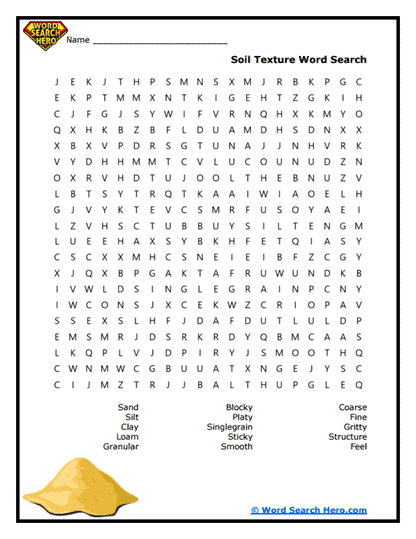
This word search introduces students to the different types and qualities of soil textures. Vocabulary includes words such as sand, silt, clay, and loam, alongside adjectives like “gritty” and “smooth” that describe soil feel. Students learn how soil texture affects water retention, plant growth, and land management. It serves as a foundation for understanding how […]

View More
Water Words Word Search

Water Words

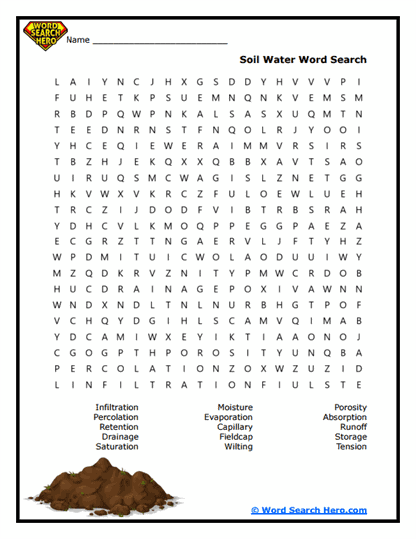
This word search is all about soil water processes and related terminology. Students encounter key concepts such as infiltration, percolation, drainage, and saturation, which describe how water moves through and interacts with soil. It also includes words describing water availability and retention, such as fieldcap and wilting. The activity gives learners a broader understanding of […]

View More
Organism Oasis Word Search

Organism Oasis

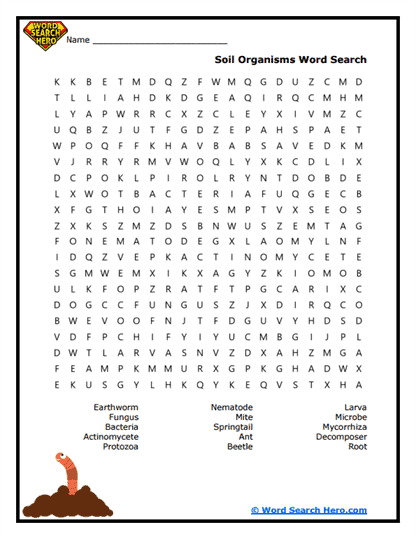
This worksheet dives into the biological world of soil, showcasing a variety of organisms that live beneath the surface. Vocabulary words include earthworm, bacteria, fungus, nematode, and protozoa, representing different types of soil life. These organisms play essential roles in nutrient cycling, soil health, and decomposition. The puzzle introduces students to the biodiversity hidden in […]

View More
Erosion Expedition Word Search

Erosion Expedition

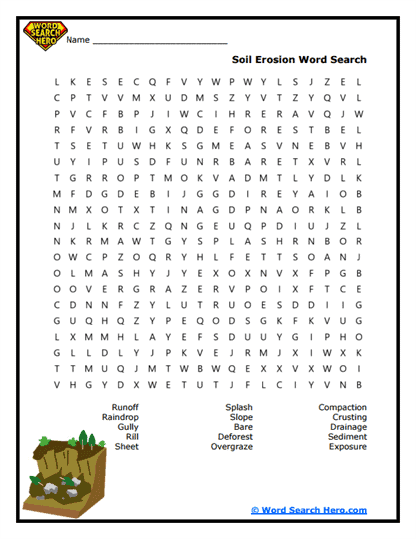
This word search focuses on the causes, types, and effects of soil erosion. Vocabulary includes natural forces like runoff and raindrop, and human impacts such as deforestation and overgrazing. Terms like compaction, sediment, and splash detail the physical processes of soil movement. Through this activity, students explore how erosion shapes landscapes and affects environmental sustainability. […]

View More
Conservation Covers Word Search

Conservation Covers

This word search centers around practices and methods used to conserve soil. Vocabulary includes terms like contour, terrace, covercrop, and windbreak, which are common soil conservation strategies. It also features supportive techniques such as buffer zones, rotation, and checkdams. Through this activity, students become familiar with real-world practices used in agriculture and land management to […]

View More
Usage Universe Word Search

Usage Universe

This word search highlights the many uses and functions of soil in daily life and industrial applications. Vocabulary includes farming, gardening, construction, mining, and wetlands-each representing a way soil supports human activity or ecosystems. It also includes composting, reforestation, and roadbed, connecting soil to restoration and infrastructure. This worksheet broadens students’ understanding of the vital […]

View More
Chemistry Crawl Word Search

Chemistry Crawl

This worksheet explores the chemical makeup and properties of soil. Vocabulary includes pH, nitrate, phosphate, potassium, and calcium-essential nutrients for plant growth. It also features elements and ions such as magnesium, iron, and cation exchange processes. Students gain insight into how chemical interactions in soil affect fertility, plant health, and environmental balance. This word search […]

View More
Formation Focus Word Search

Formation Focus

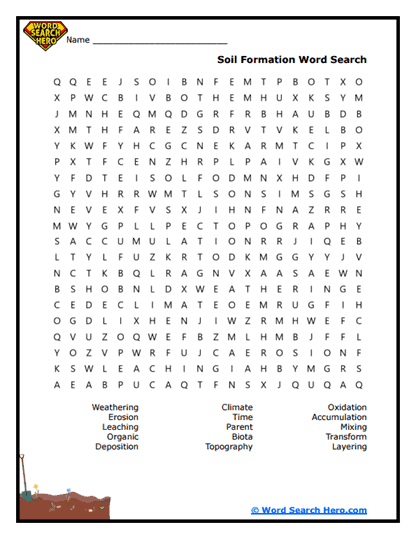
This word search introduces vocabulary related to how soil forms and changes over time. Words like weathering, erosion, and deposition describe natural processes, while terms like oxidation and leaching highlight chemical changes. The list also includes biological and environmental factors like climate, biota, and parent material. The activity provides a comprehensive look at the forces […]

View More
Property Puzzle Word Search

Property Puzzle

This word search delves into the physical and measurable characteristics of soil. Students encounter terms like texture, color, temperature, and porosity, all of which describe how soil looks, feels, and functions. Other words, such as permeability and plasticity, introduce more technical aspects of soil behavior. This vocabulary helps learners grasp how soil is classified and […]

View More

About Our Soil Science Word Searches

Soil isn’t just the surface layer we ignore until it sticks to our boots-it’s a chemically active, biologically diverse, and physically structured medium that drives nearly every terrestrial process on Earth. These word searches are designed not as filler activities, but as concept-mapping tools-each one reinforces the language of soil science through cognitive pattern recognition, helping learners internalize terminology that supports understanding of deeper scientific frameworks. The more fluent students become in the vocabulary, the more adept they are at navigating models, interpreting data, and asking scientifically valid questions about how the ground beneath them actually works.

Understanding what soil is means grasping its vertical and physical architecture. Horizon Hunt introduces students to the concept of soil stratification-how distinct layers, or horizons, form due to processes like organic matter accumulation, leaching, mineral weathering, and parent material breakdown. These layers aren’t arbitrary labels; they reflect long-term physical, chemical, and biological transformations that determine soil function. Concepts like the O, A, B, and C horizons are essential in land-use planning, agriculture, and ecosystem management. Reinforcing these terms helps learners distinguish soil from just “dirt.”

That structural understanding deepens with Texture Teams, which centers on soil particle size and shape. Texture isn’t just about feel-it governs porosity, permeability, root penetration, and erosion susceptibility. Sand, silt, and clay differ not only in dimension but also in surface area, reactivity, and how they influence cation exchange and water movement. Including terms like granular, blocky, and singlegrain introduces learners to soil structure-aggregates that affect aeration and compaction dynamics. Together, these two puzzles establish a physical foundation for thinking about how soils behave.

Water movement through soil is not intuitive; gravity interacts with capillarity, and retention doesn’t always correlate with permeability. Water Words brings in core concepts such as percolation, saturation, and field capacity, offering a scaffold to understand unsaturated flow, hydrostatic tension, and water availability to plants. Learners encounter how porosity varies with texture and structure, how infiltration differs from absorption, and why wilting point matters for irrigation strategies. This puzzle supports an understanding of soil hydrology-critical for agriculture, civil engineering, and climate modeling.

Soil isn’t just a passive filter or mechanical support; it’s a dynamic habitat. Organism Oasis addresses soil biology by spotlighting organisms that decompose organic matter, fix nitrogen, form symbiotic relationships, or regulate soil structure. Mycorrhizae enhance nutrient uptake through fungal-root symbiosis, while actinomycetes produce antibiotics that suppress pathogens. Even taxa like springtails and mites influence microbial communities through trophic interactions. This word search reinforces the idea that soil is a living system-a microbial engine central to nutrient cycling, carbon sequestration, and biotic resilience.

Disturbances to soil structure and biology often begin with surface-level degradation. Erosion Expedition identifies the mechanical and anthropogenic drivers of soil loss-runoff, splash, overgrazing, and deforestation-terms that mark where physical geography and human land use collide. Compaction and crusting further reduce infiltration, exacerbating degradation. These aren’t just buzzwords; they reflect field-observed processes that alter slope stability, reduce organic content, and impair water quality. This puzzle strengthens vocabulary essential for understanding geomorphology, hydrology, and ecological conservation.

The scientific contrast to erosion is active land stewardship. Conservation Covers introduces vocabulary from soil conservation science-strategies like terracing, contour farming, and cover cropping that slow runoff, enhance infiltration, and build organic matter. Checkdams, filter strips, and windbreaks are all mitigation tools developed through agronomic research to restore or maintain soil functionality. By learning this terminology, students start to see soil not as a static background, but as a system that can be managed, degraded, or regenerated depending on practice and policy.

Functional soil connects directly to human systems. Usage Universe compiles the many roles soil plays in infrastructure, ecosystems, and human economies. From roadbed engineering to waste containment, soil’s bearing capacity, hydraulic conductivity, and filtration properties are indispensable. Wetlands, for example, act as biogeochemical filters due to soil’s unique redox gradients. This puzzle provides context for how soil enables restoration (reforestation), resource extraction (mining), and land reclamation (composting, reclamation). Recognizing these use cases is foundational in environmental science, land-use planning, and sustainability education.

The next layer of complexity comes at the molecular level. Chemistry Crawl targets the chemical properties that govern soil fertility and nutrient cycling. The presence of nitrate, phosphate, and potassium matters not just as nutrients but as chemically mobile ions influenced by pH, cation exchange capacity, and salinity. Understanding carbonates and base saturation supports the interpretation of soil tests and liming recommendations. This puzzle helps develop a working knowledge of soil chemistry, particularly as it applies to plant science, environmental monitoring, and sustainable agriculture.

How those chemicals, structures, and lifeforms ended up in the soil in the first place is the subject of Formation Focus. Terms like weathering, oxidation, and leaching describe slow, energy-driven transformations powered by wind, water, temperature gradients, and biological metabolism. Parent material composition, climate regime, and topography shape soil profiles over millennia. This word search provides vocabulary for geomorphological and pedological processes-students gain an appreciation for how landscapes evolve into ecosystems, and why soils are never static.

To round out the scientific understanding, Property Puzzle investigates measurable traits used to classify and monitor soils in both research and applied contexts. Parameters like porosity, plasticity, and resilience tie into mechanical behavior and land suitability. Tilth, temperature, and color serve as indicators of aeration, microbial activity, and oxidation states. These aren’t cosmetic features; they’re proxies for function. By learning to name and recognize these properties, students prepare to interpret lab data, field observations, and predictive soil models.

What Is Soil Science?

Let’s start with a surprisingly philosophical question: what is soil, really? Is it just broken-up rock? Old leaves? A mushy mess of stuff in your backyard after it rains? Soil science-the study of soil’s formation, composition, properties, and function-tells us that soil is all of those things, and so much more. It’s a living, breathing matrix where geology meets biology, where chemistry dances with water, and where nearly every terrestrial ecosystem begins.

At its core, soil science is about understanding the thin skin of Earth that supports almost all life as we know it. It’s where seeds sprout, trees anchor, water filters, and nutrients cycle. Soil doesn’t just hold plants up-it feeds them, hydrates them, protects them. It moderates temperature, captures carbon, and cradles ancient fossils. Without it, agriculture would vanish, forests would collapse, and even our climate would spiral. That’s a lot of responsibility for something we step on without a second thought.

To make sense of it all, scientists divide soil into layers (called horizons), study its physical traits (texture, color, density), and investigate the critters and chemicals hidden within. Think of soil as a lasagna: multiple layers stacked atop one another, each with a unique flavor, texture, and role in the dish. The top layer-rich in humus and organic matter-is where most biological activity happens. Beneath that, minerals accumulate, water percolates, and rocks slowly weather into fertile earth.

Soil also has a chemical personality. It can be acidic or alkaline (measured by pH), nutrient-rich or barren, salty or balanced. Elements like nitrate, phosphate, and potassium help plants grow, while the soil’s ability to retain moisture and exchange ions determines how accessible those nutrients really are. This is where chemistry and biology meet: microbes help decompose organic material into plant-ready nutrients, while roots and fungi interact to absorb what they need. It’s like a silent marketplace beneath our feet, bustling with exchanges.