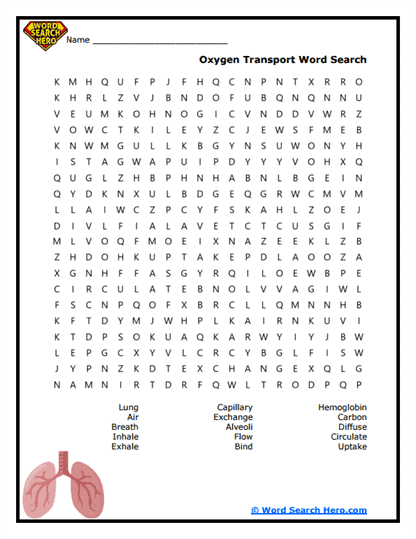
About Our Circulatory System Word Searches
Circulatory System word searches introduce students to the vocabulary used to describe how blood moves throughout the body and delivers essential materials to cells. These printable puzzles help learners become familiar with key terms related to the heart, blood vessels, and the transportation of oxygen and nutrients. Before students explore how this body system functions in detail, it often helps to first recognize the language used to describe its parts and processes.
Students studying the circulatory system may encounter words such as heart, artery, vein, capillary, blood, circulation, and oxygen. These terms appear frequently in life science and health lessons, and recognizing them helps students better understand how the body transports important substances needed for survival. A word search offers an engaging way to reinforce these terms while strengthening vocabulary and observation skills.
Because the activity feels like a puzzle rather than a traditional worksheet, it can make learning anatomy vocabulary more enjoyable. Teachers often use these printables during science centers, review sessions, independent practice, or early finisher activities. Parents and homeschool educators can also include them in lessons as a way to introduce circulatory system vocabulary in an interactive format.
As students search for the words in the puzzle grid, they strengthen concentration, visual scanning, and pattern recognition skills. At the same time, they are building familiarity with the scientific language used to describe how blood moves through the body.
Understanding the Circulatory System
The circulatory system is responsible for transporting important materials throughout the body. It carries oxygen, nutrients, hormones, and other substances to cells while also removing waste products.
At the center of this system is the heart, a powerful muscle that pumps blood through a network of blood vessels. Arteries carry blood away from the heart, veins return blood to the heart, and tiny vessels called capillaries allow substances to move between the blood and body tissues.
This constant movement of blood helps maintain the body’s balance and supports the work of other organ systems. For example, the circulatory system works closely with the respiratory system to deliver oxygen and remove carbon dioxide.
Word searches reinforce this learning by giving students repeated exposure to the key terms used when studying how blood circulates through the body.
Paul’s Pro-Tip
A highly effective extension for this puzzle is a “trace the journey” activity. After students complete the word search, ask them to imagine a drop of blood traveling through the circulatory system.
Students can describe the path the blood might take-from the heart through arteries, into smaller vessels, and back to the heart through veins. Encourage them to use vocabulary from the puzzle while explaining the journey.
This activity adds strong instructional value because it helps students visualize how the circulatory system works as a continuous loop. Teachers and homeschool educators can also quickly see whether students understand how the different parts of the system connect.
Helping Students Visualize Blood Circulation
Understanding the circulatory system helps students see how the body delivers oxygen and nutrients to every part of the body. Without this system, cells would not receive the materials they need to function properly.
Learning circulatory system vocabulary also helps students interpret diagrams, models, and science explanations about how the heart and blood vessels operate. This knowledge supports later learning in biology, health science, and medicine.
A word search can serve as an introduction to a human body systems unit or as a review after students have studied the circulatory system in class. After completing the puzzle, educators can encourage students to connect the vocabulary with body diagrams, heart models, or discussions about healthy habits that support heart health.
When students build confidence with circulatory system vocabulary, they gain the language and understanding needed to explore how the body transports life-supporting materials throughout the body.
Frequently Asked Questions
What is the main function of the circulatory system?
The circulatory system moves blood throughout the body, delivering oxygen and nutrients to cells and removing waste products.
What organ powers the circulatory system?
The heart acts as a pump that pushes blood through the network of blood vessels.
What are the main types of blood vessels?
The main types of blood vessels are arteries, veins, and capillaries.
Why is blood circulation important for the body?
Blood circulation ensures that cells receive the oxygen and nutrients they need to survive and function properly.
What hands-on activity can follow this puzzle?
Students can draw a simple diagram showing the heart and major blood vessels and label the parts using vocabulary from the puzzle.