Choose a topic !

Geophysics Word Searches

Survey Methods Word Search

Survey Methods

The “Survey Methods” introduces students to various methods and tools used in geophysical surveys. Words like *Seismic*, *Gravity*, *Magnetic*, and *Radar* reflect the different types of data collected during geological fieldwork. It also includes essential terms like *Remote*, *Mapping*, and *Fieldwork*, which highlight the application and scope of these methods. Students complete this activity by […]

View More
Earth Layers Word Search

Earth Layers

The “Earth Layers” explores the internal structure of the Earth, introducing terms like *Crust*, *Mantle*, *Core*, and *Lithosphere*. It also includes advanced vocabulary like *Asthenosphere*, *Moho*, and *Transition*. These words help students understand geological processes and the layered composition beneath Earth’s surface. The word search provides a visual and interactive means to reinforce this scientific […]

View More
Seismic Waves Word Search

Seismic Waves

In the “Seismic Waves,” students explore vocabulary tied to earthquake waveforms and seismic activity. Words like *Pwave*, *Swave*, *Bodywave*, *Amplitude*, and *Velocity* describe the behavior of seismic energy. Other terms such as *Epicenter*, *Focus*, and *Shock* provide insight into earthquake dynamics. This worksheet helps learners link vocabulary with Earth movement and tectonic studies. Searching for […]

View More
Magnetic Fields Word Search

Magnetic Fields

The “Magnetic Fields” focuses on concepts and vocabulary related to magnetism in geophysics. Students find words like *Magnetism*, *Polarity*, *Declination*, *Flux*, *Fieldline*, and *Dip*. The search also includes tools and effects such as *Compass*, *Corefield*, and *Disturbance*. These words give students a foundation for understanding Earth’s magnetic forces and how they’re measured. This activity improves […]

View More
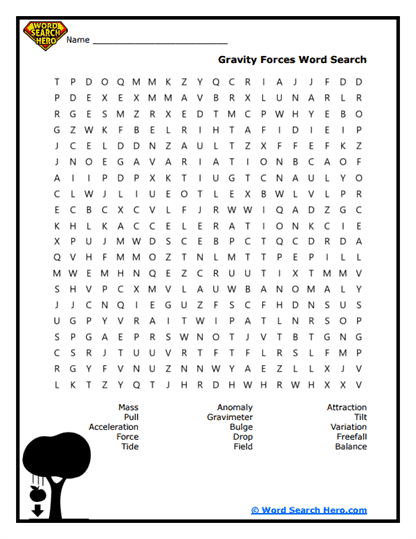
Gravity Forces Word Search

Gravity Forces

The “Gravity Forces” teaches vocabulary related to gravitational science and forces acting on Earth. Terms include *Mass*, *Pull*, *Acceleration*, *Gravimeter*, *Anomaly*, and *Tilt*. Other words such as *Freefall*, *Field*, and *Balance* help students understand how gravity affects objects and is measured scientifically. This vocabulary is essential for understanding physics and Earth science. This worksheet strengthens […]

View More
Rock Stress Word Search

Rock Stress

The “Rock Stress” introduces students to the terminology of stress and strain in rock layers. Words like *Stress*, *Strain*, *Fracture*, *Compression*, and *Tension* describe geological processes. The puzzle also includes words like *Rupture*, *Elastic*, *Brittle*, and *Ductile*, which explain the physical behavior of rocks. This word search links directly to plate tectonics and rock deformation. […]

View More
Heat Flow Word Search

Heat Flow

The “Heat Flow” explores terms related to thermal energy transfer in Earth’s interior. Vocabulary includes *Heat*, *Flux*, *Gradient*, *Conduct*, and *Convection*. Also featured are *Radiate*, *Cool*, *Flow*, *Energy*, and *Geothermal*. These words help students understand how heat moves within the Earth and affects geological processes. Engaging with thermal vocabulary enhances reading comprehension and science literacy. […]

View More
Electric Traits Word Search

Electric Traits

The “Electric Traits” features vocabulary related to electricity and its geophysical applications. Students find words such as *Charge*, *Current*, *Voltage*, *Resistivity*, and *Conductivity*. Other terms include *Shock*, *Signal*, *Dipole*, and *Response*, which are vital in studying Earth’s subsurface using electrical properties. The word search highlights how electricity is used to investigate geology. This word search […]

View More
Survey Tools Word Search

Survey Tools

The “Survey Tools” introduces students to common equipment used during field surveys. Vocabulary includes *Drill*, *Tripod*, *Hammer*, *Compass*, and *Notebook*. Tools like *Sensor*, *Antenna*, *Radar*, and *Backpack* reflect what geophysicists carry into the field. This word search gives students insight into the practical side of geoscience. This activity boosts vocabulary related to scientific equipment and […]

View More
Applied Geophysics Word Search

Applied Geophysics

The “Applied Geophysics” focuses on practical geological and geophysical applications. Students explore terms like *Sinkhole*, *Earthquake*, *Landslide*, and *Volcano*. Also included are *Pipeline*, *Wellsite*, *Bridge*, *Survey*, and *Mine*. These words help learners understand how geophysics is used in infrastructure, hazard assessment, and resource exploration. This search enhances vocabulary related to real-world geological applications. It reinforces […]

View More

About Our Geophysics Word Searches

This collection is built around the language that geophysicists use to describe the forces, properties, and structures of the Earth. Each puzzle is not just a vocabulary exercise-it’s a structured opportunity to reinforce how scientific terms are embedded in real processes and measurements. Word searches are effective because they force visual pattern recognition, repetition, and detail-oriented engagement-exactly the type of cognitive tasks science learning depends on.

Geophysics depends on precise, abstract terms that describe the physical nature of Earth’s systems. In this context, language is data. A word like resistivity or anomaly doesn’t just describe an idea-it points to a method, a tool, a dataset, or a theoretical model. These puzzles reflect that layered complexity while remaining accessible, and they follow the logic of how scientists think about Earth’s measurable phenomena: not in isolated facts, but in interconnected systems.

Survey Methods and Survey Tools form the foundation of geophysical work-because before there’s analysis, there’s observation. These puzzles are about how data gets collected. Whether by deploying seismic arrays, conducting magnetic surveys, or dragging a gravimeter across volcanic slopes, the focus here is on geophysical reconnaissance. Tools like the tiltmeter, antenna, and notebook are not just field accessories; they are essential interfaces between the Earth’s signals and the models built from them. The inclusion of terms like remote, logging, and mapping underlines that most geophysical data is indirect and must be interpreted through instrumentation and inference. Fieldwork is rarely glamorous-often muddy, sometimes tedious-but it’s where theory meets terrain.

Earth Layers and Rock Stress move directly into the physical structure of Earth and the forces acting within it. These puzzles support spatial reasoning about internal boundaries: crust, mantle, core, and the often-forgotten Moho (Mohoroviฤiฤ‡ discontinuity), where seismic waves abruptly speed up due to compositional change. The asthenosphere and lithosphere reflect mechanical behavior, not just depth, which is why they show up alongside terms like pressure, density, and transition. The Rock Stress vocabulary focuses on deformation-how tectonic forces produce features like faults, folds, and ruptures. Words like brittle, ductile, and creep describe different strain regimes, and they reflect real rock behavior under long timescales and varying temperatures. This section pairs internal structure with internal stress-because you can’t understand one without the other.

Seismic Waves and Applied Geophysics are grouped around Earth’s dynamic behavior and the ways those dynamics intersect with society and infrastructure. Seismic waves-P-wave, S-wave, bodywave, surface-are the backbone of both earthquake science and subsurface imaging. The science behind terms like amplitude, refraction, and arrival is pure physics: wave behavior in heterogeneous media. These terms also appear in petroleum exploration, earthquake early-warning systems, and deep Earth tomography. Meanwhile, Applied Geophysics expands the context: it’s where terms like sinkhole, landslide, and pipeline emerge. This is where geophysics becomes engineering. A survey isn’t academic-it determines whether a bridge is safe, whether a quarry will collapse, or whether a faultline threatens infrastructure. These aren’t abstract terms; they’re operational concerns that influence risk models and public safety.

Gravity Forces and Magnetic Fields address the planet’s passive force fields-measurable, mappable, and essential for understanding subsurface structure. Gravity anomalies help geophysicists detect hidden features such as salt domes, mineral deposits, or voids. Vocabulary like gravimeter, tilt, and freefall captures how subtle variations in gravitational acceleration tell us about mass distribution beneath our feet. Anomaly, in this context, doesn’t mean “weird”-it means “interesting,” because it suggests an underlying structure not visible at the surface. The Magnetic Fields puzzle uses a different set of physical principles: ferromagnetism, magnetic inclination, secular variation. Terms like magnetite, declination, and dip reveal how magnetic minerals align with Earth’s past magnetic fields, preserving a record of plate motion and tectonic history. Earth’s corefield generates the magnetic shield that protects our atmosphere from solar radiation, and the vocabulary here reflects both that geodynamo and its geomagnetic fingerprints.

Heat Flow and Electric Traits shift into energy transfer and electrical properties, which are crucial for understanding both deep Earth processes and practical applications. Heat flow isn’t just about warmth-it’s about the redistribution of energy from the inner Earth outward, driving convection in the mantle and producing the conditions for plate tectonics and volcanism. Words like gradient, flux, and geothermal aren’t decorative; they’re measurable properties tied directly to tectonic activity and resource potential. Electric Traits introduces resistivity, conductivity, and dipole, all of which are central to geophysical imaging. Electrical methods can reveal groundwater, map ore bodies, and define subsurface layering. The difference between shock and signal is the difference between noise and data-terms that matter when modeling electromagnetic responses in the subsurface.

What Is Geophysics?

Simply put, geophysics is the study of the physical properties and processes of the Earth. That includes everything from how sound waves move through rocks to how gravity varies across different regions. If geology is the study of the Earth’s structure, then geophysics is how we take its pulse. It’s the physics of the planet-measured, mapped, and modeled to make sense of the unseen.

Think of Earth like a giant, layered cake. Geophysicists don’t get to cut a slice and look inside-but they have clever tools that let them sense what’s happening beneath the icing. Just like a doctor might use an MRI to look inside a human body, geophysicists use seismic waves, magnetic fields, and electrical signals to “see” what’s below the surface. They might measure how long it takes an energy wave to bounce back, or detect tiny shifts in gravity that suggest a hidden cavern. Through these indirect methods, they build a picture of Earth’s inner workings.

Geophysics sits at the crossroads of Earth science, physics, engineering, and even mathematics. It helps scientists locate underground water, predict earthquakes, find oil or minerals, study volcanoes, and plan safe places for tunnels, bridges, and buildings. It’s used in archaeology, environmental science, and space exploration. Wherever there’s a question about what lies beneath the surface-or how forces shape our world-geophysics is part of the answer.