Choose a topic !

Lab Equipment Word Searches

Measurement Mania Word Search

Measurement Mania

This worksheet focuses on common measurement tools used in a laboratory setting. Students search for instruments such as balances, thermometers, and rulers, which are essential for quantifying data in experiments. These tools relate to measuring weight, temperature, time, and volume accurately. Completing the word search helps students become familiar with the vocabulary of precise measurement […]

View More
Glassware Galore Word Search

Glassware Galore

This word search features types of laboratory glassware, which are containers and tools commonly used in experiments. Vocabulary words include beakers, flasks, and pipettes, among others. These items are used for holding, transferring, and measuring substances. By finding and identifying these items, students familiarize themselves with the structure and purpose of common glassware in lab […]

View More
Heat Hunt Word Search

Heat Hunt

This worksheet is centered around heating tools used in laboratories. The vocabulary includes Bunsen burners, hotplates, and flame-related apparatus. These tools are essential for conducting experiments that involve heating substances or maintaining reactions at specific temperatures. Students locate each term to reinforce their understanding of these important instruments. This puzzle enhances vocabulary retention of heat-related […]

View More
Mixing Madness Word Search

Mixing Madness

This word search focuses on tools used for stirring, mixing, and blending substances in the lab. Words such as stirrer, vortex, and spatula appear in the puzzle. These tools are crucial for preparing solutions and ensuring even mixtures in experiments. Searching for these terms helps students recognize the tools they will frequently handle during lab […]

View More
Storage Safari Word Search

Storage Safari

This puzzle introduces vocabulary related to storing lab equipment and materials. Students look for words like bottle, cabinet, tray, and container. These items help organize the lab and ensure materials are safely and correctly stored. The search activity helps reinforce familiarity with the items and where they belong in the laboratory setting. By working on […]

View More
Cleanup Quest Word Search

Cleanup Quest

This word search contains vocabulary associated with cleaning tools and supplies in a laboratory. Students will locate words such as brush, soap, towel, and disinfectant-related items. Cleanliness is crucial for safety and accuracy in labs, and this worksheet emphasizes the importance of hygiene. It teaches students to recognize the tools used to maintain a sterile […]

View More
Observer's Orbit Word Search

Observer’s Orbit

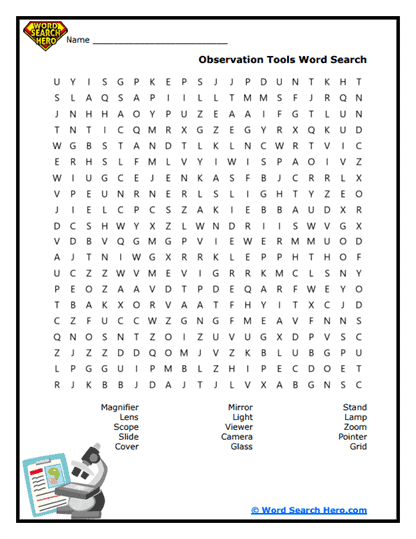
This worksheet is about tools used to observe experiments in scientific settings. Students search for terms like microscope, slide, viewer, and magnifier. These instruments help scientists collect and analyze visual data. By recognizing each tool, students learn the basic instruments involved in close observation and detailed scientific analysis. This word search promotes scientific literacy through […]

View More
Gear Grab Word Search

Gear Grab

This worksheet covers lab protective gear vocabulary, emphasizing safety equipment. Words include gloves, goggles, aprons, and masks-items that protect scientists during experiments. The puzzle encourages students to recognize and respect safety protocols. It’s a great way to review essential safety terminology. Students build a strong foundation in lab safety through this themed vocabulary puzzle. It […]

View More
Support Search Word Search

Support Search

This word search highlights support equipment used in lab experiments. Students hunt for words like tripod, stand, clamp, and base-tools that hold or stabilize other lab items. These items play a key role in setting up safe and efficient lab stations. The activity builds familiarity with lesser-known but essential lab components. By working on this […]

View More
Digital Detectives Word Search

Digital Detectives

This worksheet includes vocabulary centered around digital devices used in laboratories. Students find terms such as monitor, sensor, scanner, and printer. These tools are essential for data collection, analysis, and communication. The word search introduces students to the tech side of modern science labs. Students expand their digital literacy by learning the names and functions […]

View More

About Our Lab Equipment Word Searches

Scientific vocabulary isn’t ornamental-it’s structural. It functions like the connective tissue of experimentation, linking concepts, tools, and methods into coherent systems of investigation. Word recognition tied to scientific tools supports a learner’s ability to visualize, understand, and eventually apply the mechanisms of empirical inquiry. That’s what these word searches are built to reinforce: not memorization for its own sake, but the pattern fluency that underlies recognition and scientific comprehension.

In the cognitive sciences, spatial word-finding activities such as word searches have been linked to increased activation in visual processing regions of the brain, as well as improved semantic access. For learners, this translates into faster recognition of terms and stronger encoding of domain-specific language-essential for engaging with real laboratory tasks. When a student repeatedly encounters terms like manometer or spectrophotometer in meaningful, grouped contexts, retention deepens. Vocabulary shifts from passive exposure to active command.

The puzzles are not arranged randomly. They follow the structure of laboratory function: what tools do, how they’re used, and how they relate to the stages of scientific work. This is not just thematic design-it mirrors the functional modularity of an actual lab. A clear cognitive separation of measurement, containment, transformation, observation, safety, and digital interfacing mirrors the mental organization that scientists use when planning or analyzing experiments.

Measurement Mania focuses on instrumentation used to quantify variables-time, mass, temperature, pressure, volume, and electrical potential. Devices like thermometers, barometers, and voltmeters may differ mechanically, but they are unified in purpose: translating physical conditions into readable values. For example, a hygrometer doesn’t just indicate moisture-it provides crucial data in experiments where humidity impacts reaction rates or material properties. These tools enforce the repeatability that defines experimental science. Without reliable measurement, there is no reproducible result.

Glassware Galore, Mixing Madness, and Heat Hunt fall under procedural equipment: tools that actively change or prepare substances. Glassware Galore introduces learners to volumetric and containment vessels such as burettes, flasks, and crucibles-tools that are chemically inert, heat-resistant, and often designed for precise manipulation of fluids. Their use shapes the resolution of experiments. For instance, a narrow-necked Erlenmeyer flask minimizes evaporation and splashing during titration, enhancing accuracy.

Mixing Madness explores mechanical agitation-stirrers, vortexers, mortars and pestles-critical for ensuring homogeneity in samples. Mixing is not cosmetic; it ensures even distribution of solutes, consistent reaction kinetics, and representative sampling. Even the shape of a stir rod affects fluid dynamics in small-scale mixing. These are often overlooked tools that dramatically impact the reliability of experimental data.

Heat Hunt examines the physics of thermal transfer. Heating tools like Bunsen burners and hotplates serve more than just raising temperature; they facilitate activation energy thresholds, induce phase changes, and enable endothermic or exothermic reactions. Wire gauze, often found beneath glassware on a ring stand, diffuses heat to reduce stress fractures in glass. The inclusion of components like clamps, tongs, and crucibles in this puzzle reinforces the support structures required for safe thermal manipulation.

Storage Safari and Cleanup Quest direct attention to laboratory logistics, a dimension often omitted from textbooks but essential to actual science. Storage vocabulary isn’t trivial-it reflects an understanding of containment, categorization, and accessibility. In real laboratories, materials must be segregated not just by type, but by reactivity, flammability, and contamination potential. Whether it’s the difference between a reagent cabinet and a waste container, or the role of labeled canisters in preventing cross-contamination, the language of storage is a system of safety protocols.

Cleanup Quest brings sanitation into focus. Lab hygiene is directly correlated with the reliability of results and the safety of the environment. Residues left on glassware can introduce unexpected reagents into the next trial. Words like dispenser, rinse, and scrub signal not just cleaning practices, but procedural endpoints in chemical workflows. Even disposal tools, such as drain and bucket, reinforce the regulated removal of substances-necessary for preventing contamination and environmental hazard.

Observer’s Orbit moves toward the perceptual systems of the laboratory. Tools like magnifiers, microscopes, and slides are data acquisition instruments. They extend human senses to the microscopic or structural level, enabling identification, measurement, and classification. Observation is not passive in science; it is instrument-mediated and precision-controlled. The difference between a lens and a camera isn’t just form-it’s resolution, permanence, and data analysis potential. Including vocabulary like grid and pointer emphasizes that even the scaffolds for viewing-such as ruled slides-are part of the observational apparatus.

Gear Grab deals with personal protective equipment (PPE), which forms the interface between human physiology and laboratory hazard. Gloves are not interchangeable; nitrile, latex, and neoprene each serve different protective roles based on chemical compatibility. Goggles are not just eyewear-they must be impact-resistant and often fog-proof to maintain clarity in volatile environments. Including terms like visor, guard, and cover draws attention to layers of hazard mitigation that function in tandem.

Support Search and Digital Detectives offer contrasting but complementary roles in the lab. Support Search highlights mechanical frameworks-tripods, clamps, stands-that underlie the setup of virtually every experiment. These tools are not conceptually trivial: without them, heat sources can’t be safely elevated, glassware can’t be aligned, and reactions can’t be controlled. Equipment like pegboards and holders reflect the modularity of a lab space, offering flexibility and order.

Digital Detectives shifts the frame to instrumentation that gathers, stores, and communicates data electronically. These tools form the backbone of modern scientific analysis. Sensors detect stimuli-thermal, optical, electrical-often with sensitivities orders of magnitude beyond human perception. Devices like keypads and displays aren’t just interfaces; they are the human-machine boundary for adjusting parameters and reading outcomes. Tablets, cameras, and scanners are not peripherals-they are integrated data systems, essential for documentation, replication, and analysis.

The precision of a lab is built from the precision of its language. These word searches aim to develop not just vocabulary fluency, but scientific literacy through structured repetition, context-driven grouping, and pattern-based recognition. As scientific practice evolves with new technologies and methodologies, foundational equipment knowledge remains vital. These puzzles are a mechanism for building that foundation-one word, and one carefully located letter string, at a time.