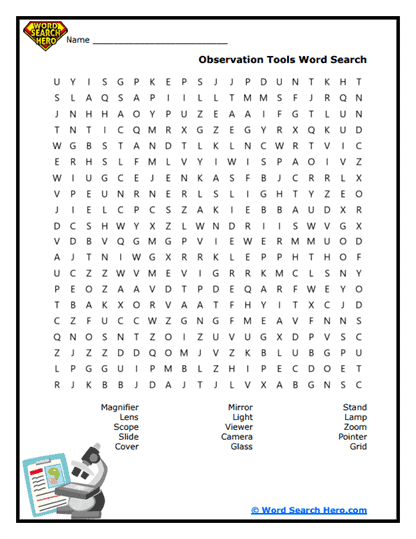
About Our Lab Equipment Word Searches
Lab Equipment word searches introduce students to the vocabulary used to describe the tools and instruments commonly found in science laboratories. These printable puzzles help learners become familiar with the names of equipment used in chemistry, biology, and general science experiments. Before students begin working with laboratory tools, it often helps to first recognize the language used to describe these instruments.
Students studying lab equipment may encounter words such as beaker, test tube, microscope, pipette, flask, thermometer, and balance. These terms frequently appear in science lessons and laboratory instructions, and understanding them helps students follow procedures and identify the tools used in experiments. A word search provides an engaging way to reinforce this vocabulary while strengthening reading, spelling, and observation skills.
Because the activity feels like a puzzle rather than a traditional worksheet, it can make learning laboratory terminology more approachable. Teachers often use these printables during science centers, independent practice, review sessions, or early finisher activities. Parents and homeschool educators can also include them in lessons as a way to introduce lab equipment vocabulary in an interactive format.
As students search for the words in the puzzle grid, they strengthen concentration, visual scanning, and pattern recognition skills. At the same time, they build familiarity with the scientific language used to describe the tools that support scientific investigation.
Understanding Common Lab Equipment
Laboratory equipment allows scientists to observe, measure, and experiment with different materials. Each tool in a lab has a specific purpose that helps researchers gather accurate data and conduct experiments safely.
For example, containers such as beakers and flasks hold liquids during experiments. Tools like pipettes help scientists transfer small amounts of liquid, while thermometers measure temperature changes. Balances are used to measure mass, and microscopes allow scientists to observe objects that are too small to see with the naked eye.
Understanding the purpose of each tool helps students follow instructions and conduct experiments more effectively. When students recognize the names of common lab equipment, they are better prepared to participate in hands-on science activities.
Word searches reinforce this learning by giving students repeated exposure to the key terms used when studying laboratory tools.
Paul’s Pro-Tip
A powerful way to extend this puzzle is to introduce a “lab equipment matching challenge.” After students complete the word search, provide pictures or diagrams of common laboratory tools.
Students can match each image to its correct name and briefly explain what the tool is used for. Encourage them to use vocabulary from the puzzle as they describe each instrument.
This activity adds strong instructional value because it connects vocabulary recognition with visual identification. Teachers and homeschool educators can quickly assess whether students understand how different pieces of equipment are used in scientific investigations.
Helping Students Prepare for Hands-On Science
Familiarity with lab equipment is an important step in helping students feel confident during experiments. When students know the names and purposes of common tools, they can better follow procedures and understand the steps involved in scientific investigations.
Learning lab equipment vocabulary also helps students interpret science textbooks, lab instructions, and classroom demonstrations. These concepts support future learning in chemistry, biology, physics, and other scientific fields.
A word search can serve as an introduction to a laboratory unit or as a review before students begin hands-on experiments. After completing the puzzle, educators can encourage students to connect the vocabulary with diagrams or demonstrations showing how each tool is used.
When students become familiar with lab equipment vocabulary, they gain the language and confidence needed to explore scientific experiments safely and effectively.
Frequently Asked Questions
What is lab equipment?
Lab equipment refers to the tools and instruments used by scientists to perform experiments and collect data.
Why is it important to learn the names of lab tools?
Knowing the names of lab equipment helps students follow experiment instructions and understand how different tools are used.
What are some common types of lab equipment?
Common tools include beakers, test tubes, flasks, microscopes, thermometers, and balances.
How does lab equipment help scientists?
Lab equipment allows scientists to measure, observe, and test substances during experiments.
What classroom activity pairs well with this puzzle?
Students can examine pictures of lab tools and match them to their names while explaining what each piece of equipment is used for.