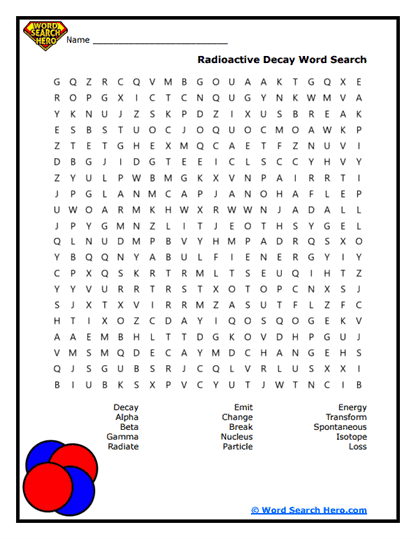
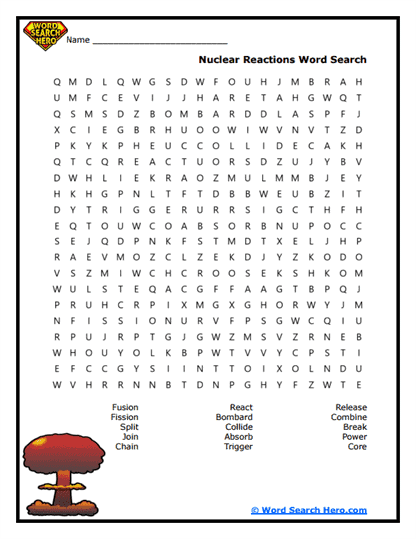
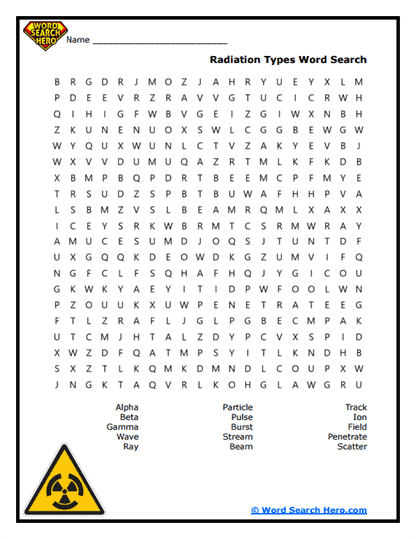
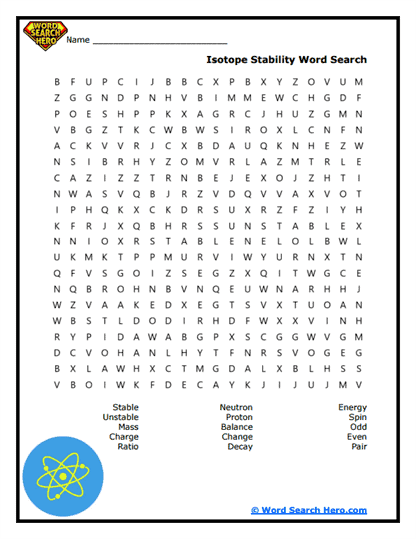
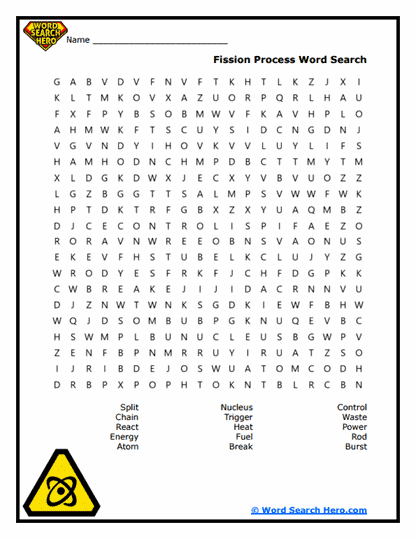
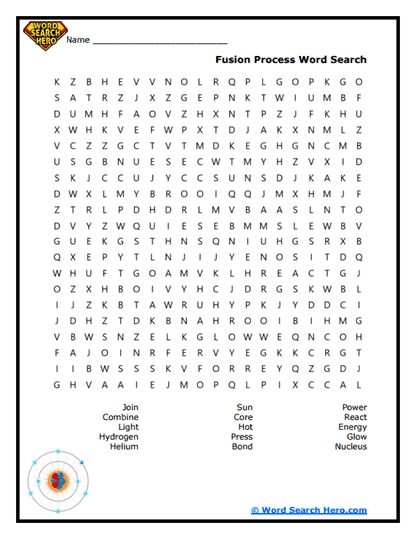
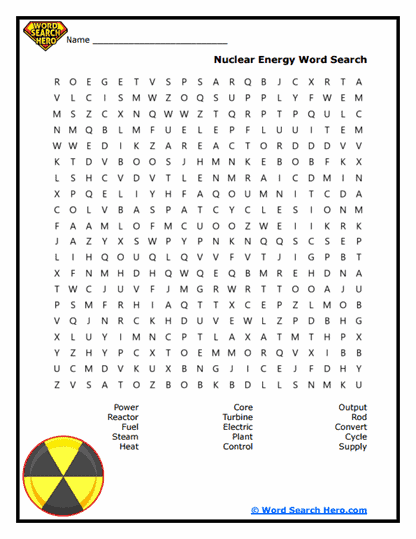
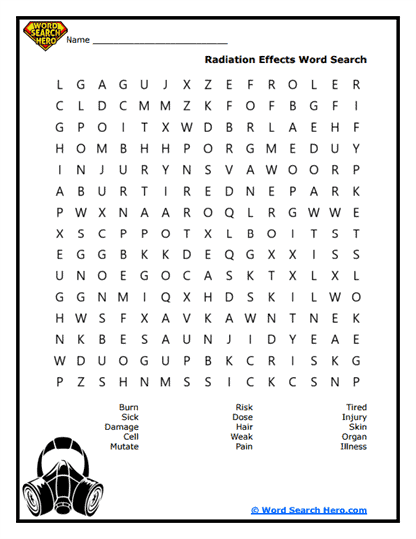
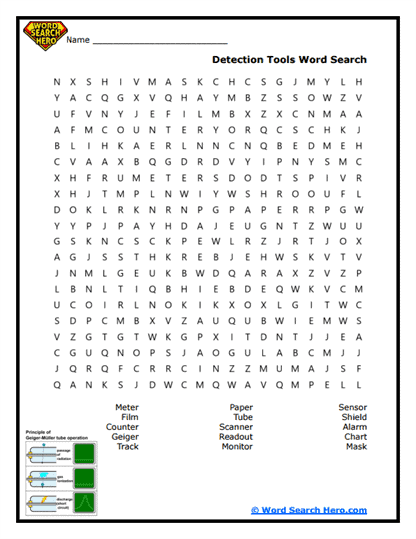
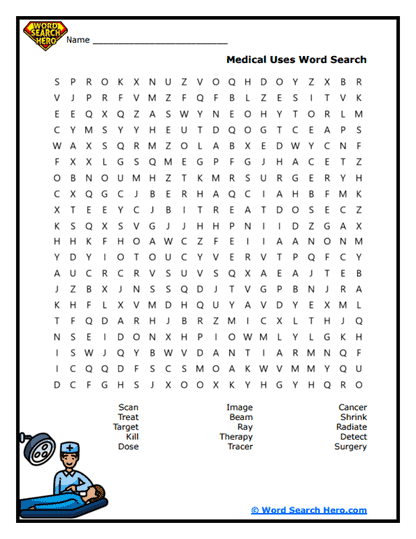
About Our Nuclear Chemistry Word Searches
Nuclear Chemistry word searches introduce students to the vocabulary used to describe the study of atomic nuclei and the changes that occur within them. These printable puzzles help learners become familiar with important scientific terms related to radioactive materials, nuclear reactions, and energy released from the nucleus of atoms. Before students explore the deeper scientific principles of nuclear chemistry, it often helps to first recognize the language used to describe these processes.
Students studying nuclear chemistry may encounter words such as nucleus, radiation, radioactive, decay, isotope, reaction, and energy. These terms frequently appear in chemistry and physics lessons and help students understand how changes within the nucleus of an atom can produce energy or transform one element into another. A word search provides an engaging way to reinforce this vocabulary while strengthening reading, spelling, and observation skills.
Because the activity feels like a puzzle rather than a traditional worksheet, it can make complex scientific vocabulary more approachable. Teachers often use these printables during science centers, independent practice, review sessions, or early finisher activities. Parents and homeschool educators can also include them in lessons as a way to introduce nuclear chemistry vocabulary in an interactive format.
As students search for the words in the puzzle grid, they strengthen concentration, visual scanning, and pattern recognition skills. At the same time, they build familiarity with the scientific language used to describe nuclear processes and atomic transformations.
Understanding Nuclear Chemistry
Nuclear chemistry is the branch of science that studies changes that occur within the nucleus of atoms. Unlike many chemical reactions that involve electrons, nuclear reactions involve the particles located in the atom’s central nucleus.
These processes can cause atoms to change into different elements or release significant amounts of energy. Some atomic nuclei are naturally unstable and may release radiation as they transform into more stable forms. This process is known as radioactive decay.
Scientists study nuclear chemistry to understand how atomic nuclei behave and how these reactions can be used in fields such as medicine, energy production, and scientific research. For example, nuclear reactions are used in medical imaging, cancer treatments, and power generation.
Learning the vocabulary associated with nuclear chemistry helps students understand how atoms can undergo powerful changes at the nuclear level.
Word searches reinforce this learning by giving students repeated exposure to the key terms used when studying nuclear reactions and radioactive processes.
Paul’s Pro-Tip
A highly effective extension for this puzzle is a “nuclear science in everyday life” discussion. After students complete the word search, ask them to research or discuss real-world uses of nuclear chemistry.
Students might explore examples such as medical imaging technologies, radiation therapy used in cancer treatment, or how nuclear energy is generated. Encourage them to connect vocabulary from the puzzle with these real-world applications.
This activity adds strong instructional value because it helps students understand that nuclear chemistry is not just a theoretical concept but a field that impacts medicine, energy, and technology. Teachers and homeschool educators can also quickly assess whether students understand how nuclear processes influence modern science.
Helping Students Understand Atomic Energy and Change
Nuclear chemistry helps scientists understand how atoms can release energy and transform through changes in their nuclei. These processes explain natural phenomena such as radioactive decay and also support technologies that provide energy and medical treatments.
Understanding nuclear chemistry vocabulary helps students interpret science lessons about atomic structure, radiation, and nuclear reactions. These ideas connect chemistry with physics and play a role in many scientific fields.
A word search can serve as an introduction to a lesson about nuclear chemistry or as a review after students have studied atomic structure and nuclear processes in class. After completing the puzzle, educators can encourage students to connect the vocabulary with diagrams of atomic nuclei or discussions about the uses of nuclear science.
When students become familiar with nuclear chemistry vocabulary, they gain the language and understanding needed to explore how powerful changes within atomic nuclei shape both natural processes and modern technologies.
Frequently Asked Questions
What is nuclear chemistry?
Nuclear chemistry is the study of reactions and changes that occur in the nucleus of atoms.
What is radioactive decay?
Radioactive decay is a process in which an unstable atomic nucleus releases energy or particles to become more stable.
What is an isotope?
An isotope is a form of an element that has the same number of protons but a different number of neutrons.
How is nuclear chemistry used in real life?
Nuclear chemistry is used in medicine, energy production, scientific research, and various technologies.
What classroom activity pairs well with this puzzle?
Students can research a real-world application of nuclear chemistry and explain how nuclear reactions are used in that technology.